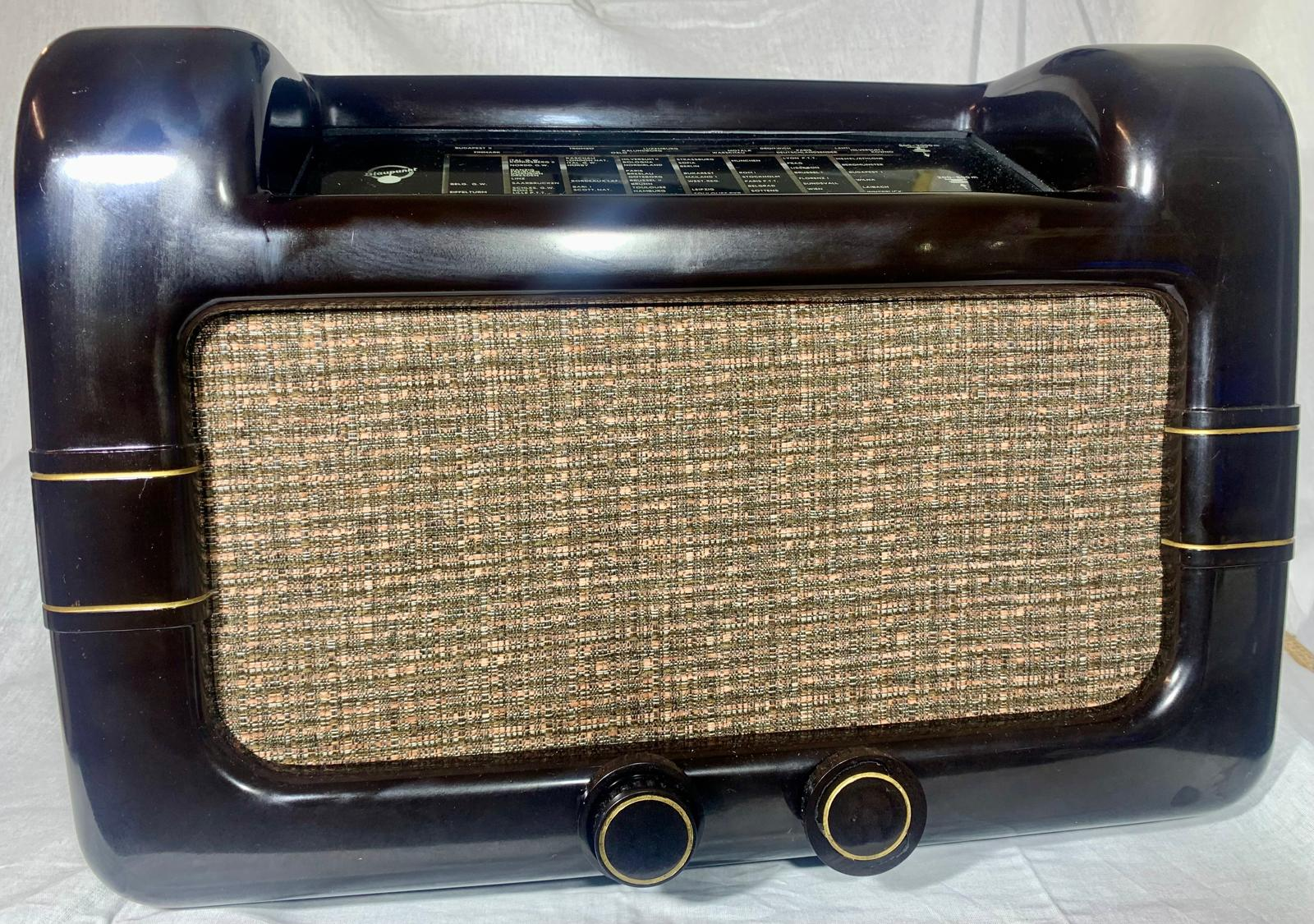
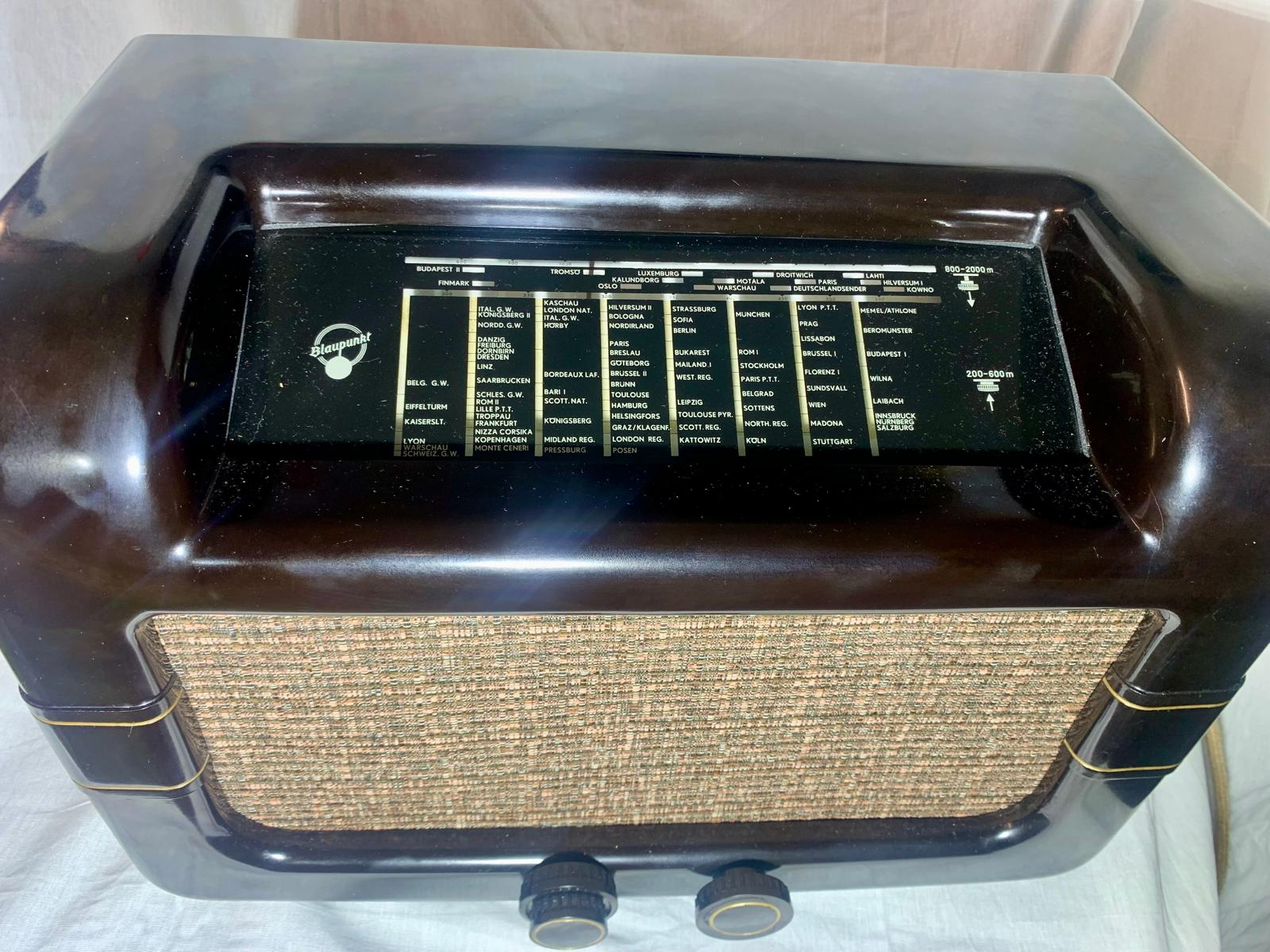
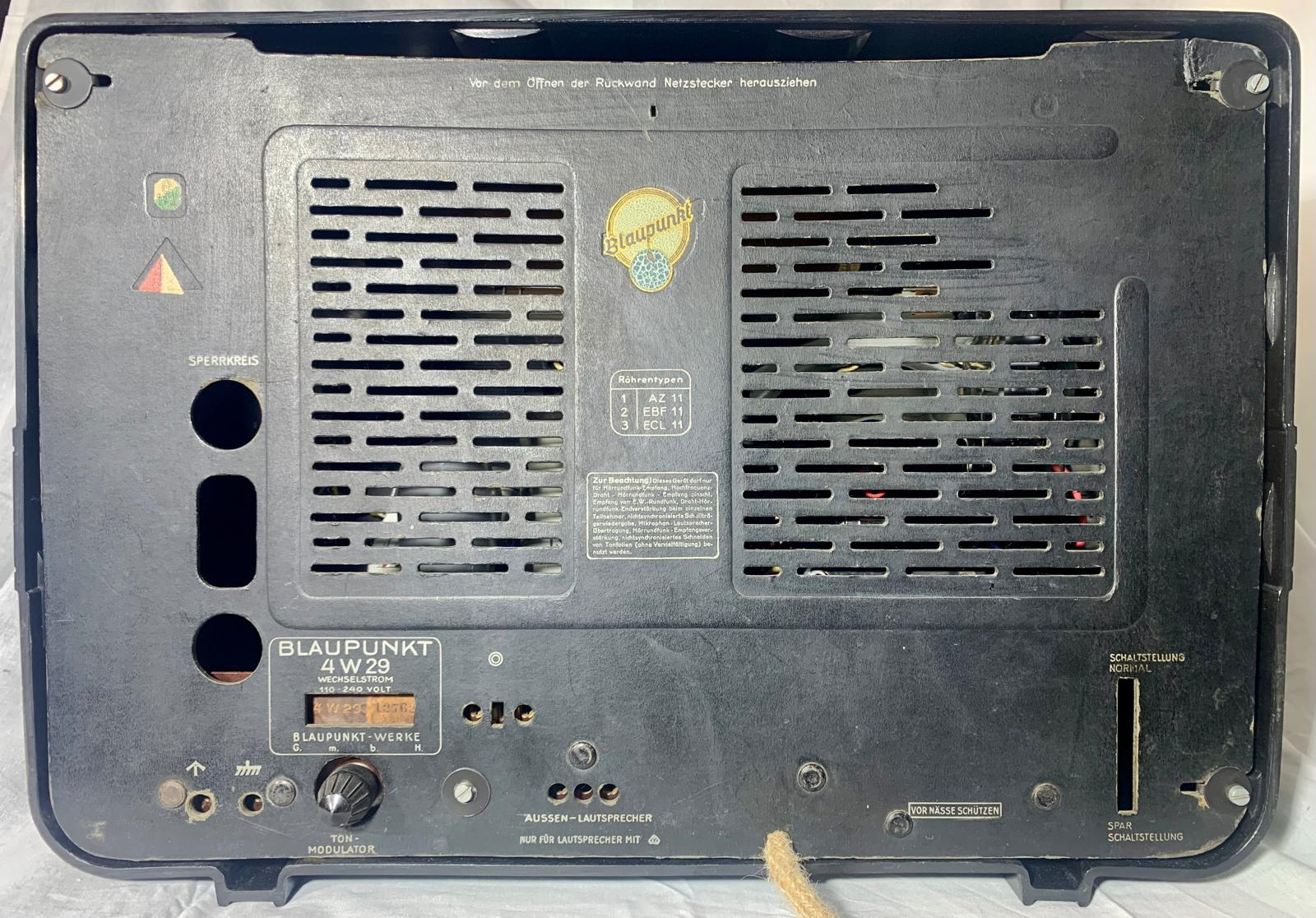
Blaupunkt 4W29 - German Table Radio from 1939/1940
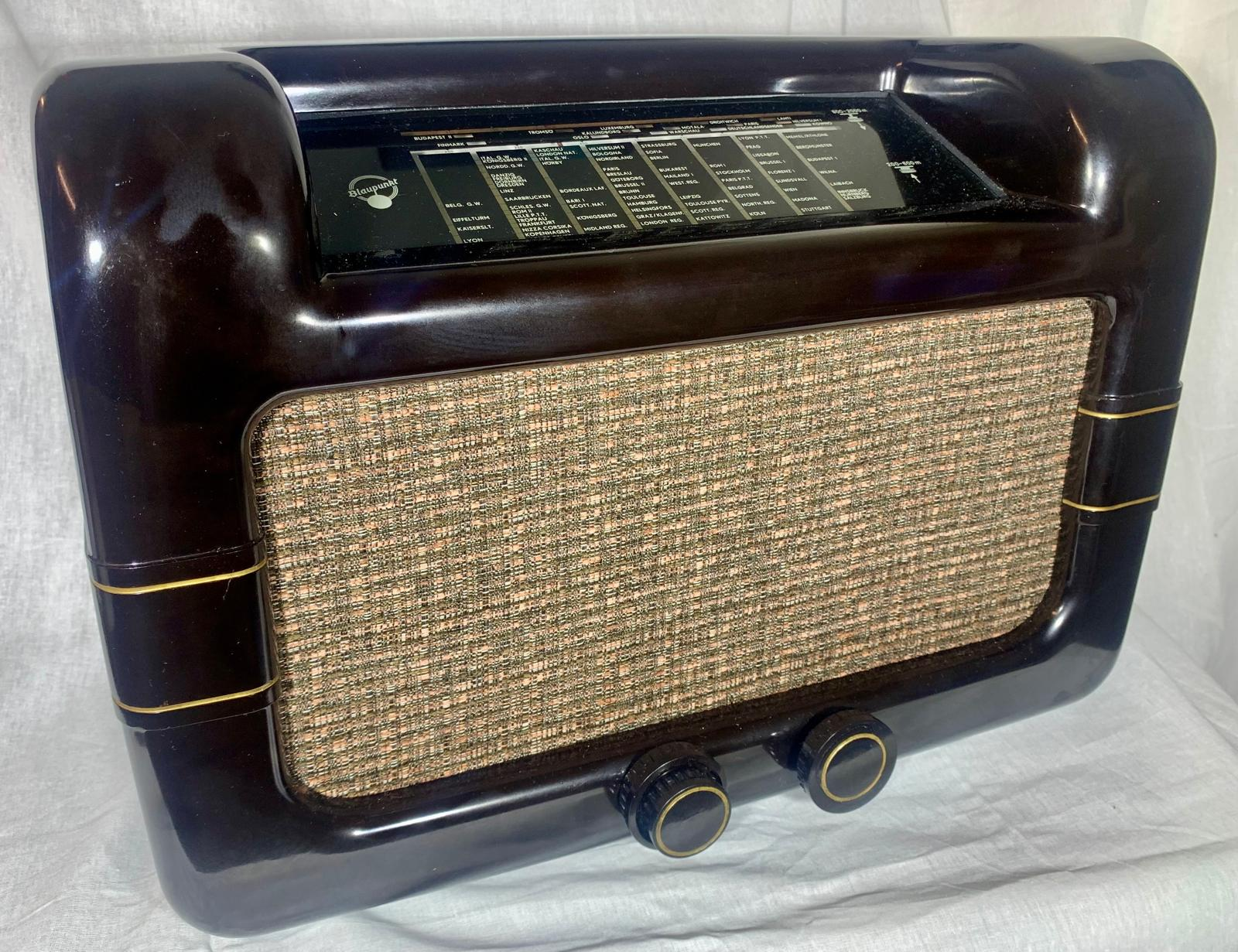
The Blaupunkt 4W29 is a German table radio from the 1939/1940 model year. It was produced by Blaupunkt, still closely associated with its earlier name “Ideal”, shortly after the blue dot quality mark had become the company name itself. Blaupunkt’s official company history describes this origin: the company began as “Ideal” in Berlin, and carefully tested products were marked with a blue dot — a sign that eventually became the brand name Blaupunkt.
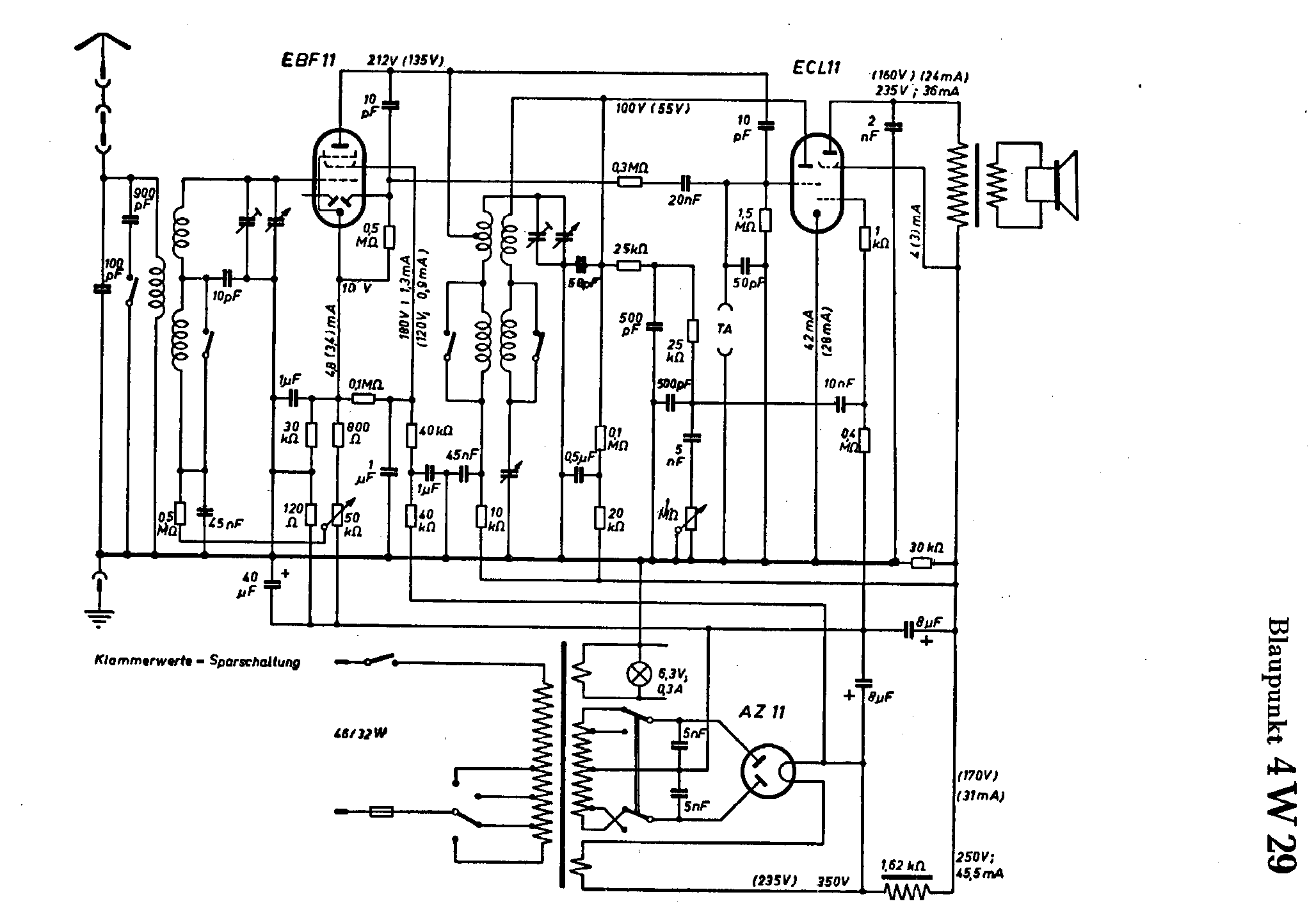
Although the 4W29 was built in a politically and historically difficult period, it is not a simple Volksempfänger-type receiver. It is a larger domestic broadcast receiver with a Bakelite cabinet, intended for normal household use. Technically, it is a two-circuit TRF receiver with regeneration, covering long wave and medium wave.
Technical Overview
| Item | Details |
|---|---|
| Manufacturer | Blaupunkt / Ideal |
| Model | 4W29 |
| Year | 1939/1940 |
| Type | Table radio |
| Circuit principle | TRF / regenerative receiver |
| Tuned circuits | 2 AM circuits |
| Wavebands | Long wave and medium wave |
| Tubes | EBF11, ECL11, AZ11 |
| Power supply | AC mains, 110 / 125 / 220 / 240 V |
| Loudspeaker | Electrodynamic loudspeaker with field coil |
| Cabinet | Dark brown mottled Bakelite / pressed material |
| Dimensions | approx. 473 × 335 × 287 mm |
| Weight | approx. 11 kg |
| Original price | 155 Reichsmark |
Data according to Radiomuseum.org and Radiomuseum Bocket.
The “W” and “GW” Versions
The model designation is important: the 4W29 is the AC mains version. Blaupunkt also offered the closely related 4GW29, an AC/DC version. The GW model used a different tube line-up — UBF11, UCL11, UY11 and U2410 — and a permanent magnet dynamic loudspeaker instead of the field-coil speaker used in the 4W29.
For restoration work, this distinction is more than just a model number detail. AC/DC radios may have a chassis connected to the mains depending on plug orientation and circuit design, while the 4W29 uses a transformer-based AC supply. Nevertheless, both types require the usual safety precautions when serviced.
Design and Construction
The 4W29 has the characteristic pre-war Blaupunkt appearance: a dark Bakelite cabinet with rounded sides, horizontal grille cloth, and a compact control layout. The cabinet is relatively large and heavy for a three-tube receiver, giving the set a solid and substantial appearance.
Its circuit is not a superheterodyne. Instead, it uses a regenerative TRF design, a simpler but still effective receiver concept. With a good antenna and proper alignment, such sets can still perform surprisingly well on medium wave, especially when used with a local AM transmitter or in areas where strong broadcast signals are available.
Restoration Note
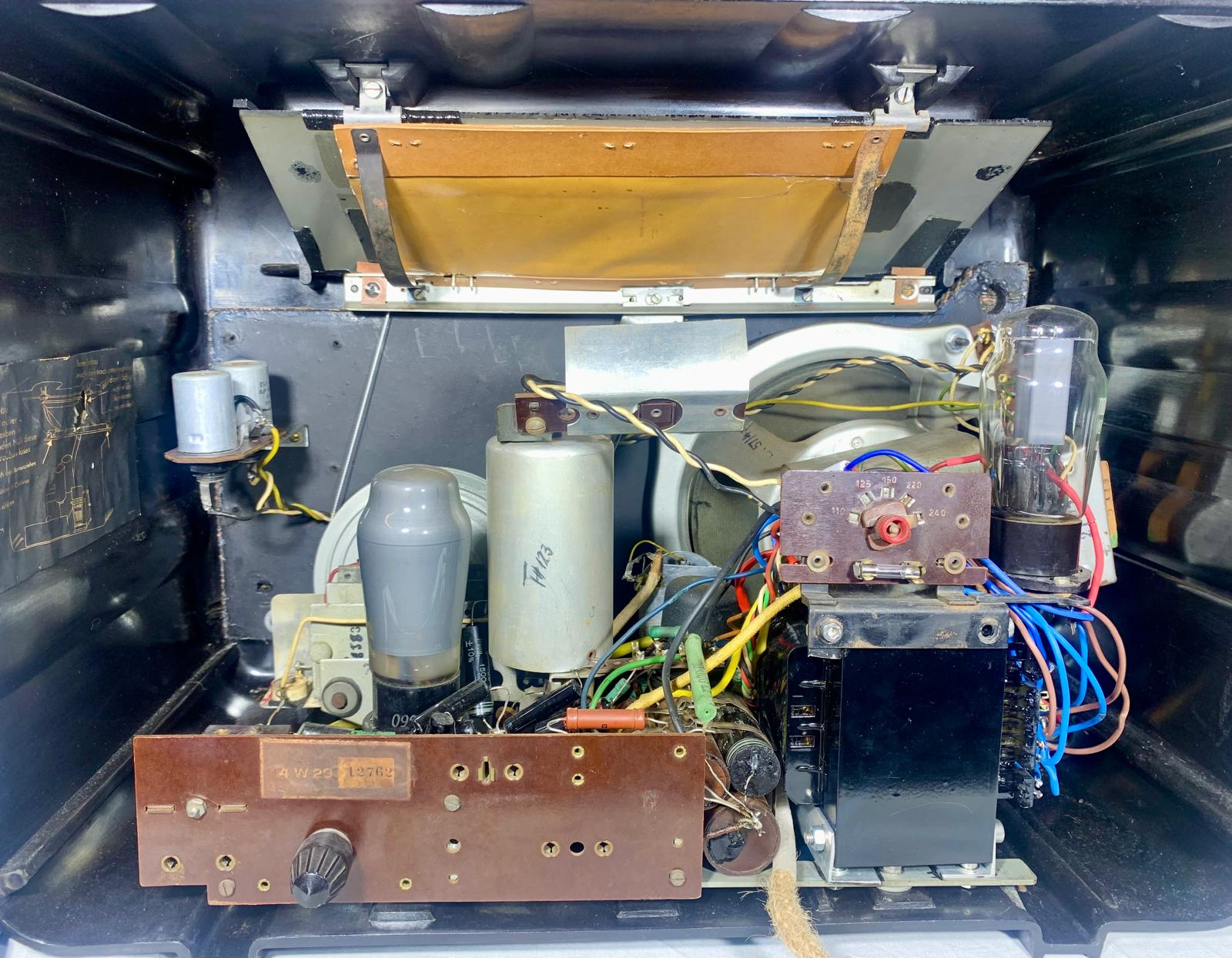
This Blaupunkt 4W29 required more work than its exterior condition might suggest. All capacitors were carefully restored in the usual way: the original capacitor bodies were opened, modern replacement components were installed inside, and the housings were resealed so that the chassis retains its original appearance as far as possible.
The old speaker cloth was also replaced. The new fabric significantly improves the visual appearance of the radio while keeping the front close to its original period style.
The dial cord was missing and was replaced with a new one. All tubes were also missing from the set. The correct tube types — EBF11, ECL11 and AZ11 — were sourced and installed.
A more unusual issue was the missing mains transformer. Since no suitable original transformer was available, a new replacement transformer was installed. This is an exception to the otherwise conservative restoration approach, but it was necessary to make the radio complete and operational again. The replacement was chosen and mounted so that it integrates visually reasonably well with the original chassis layout.
References and Further Reading
Circuit Diagram
Pictures