Eumig Eumigett 300 – An Austrian Tube Radio from the Early 1960s
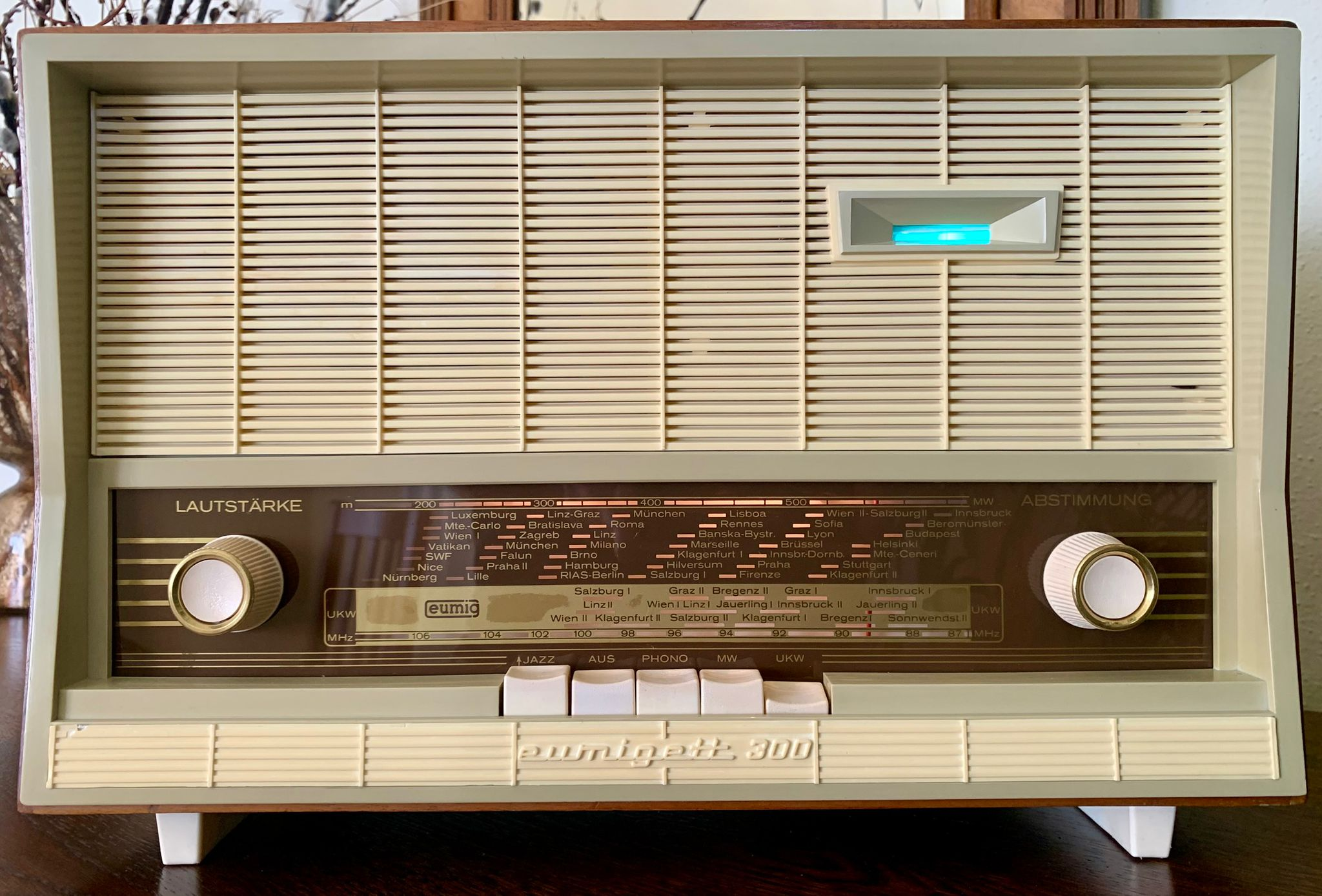
The Eumigett 300 is an Austrian tube radio from the final years of Eumig’s radio production. One thing is worth mentioning right at the beginning: this is not an Eumigette. The name is very similar, and the two are often confused, but the Eumigett 300 is a later model with a different technical construction.
While the Eumigette became almost a household name for compact Austrian post-war radios, the Eumigett 300 represents a slightly more modern generation. It still uses classic tube technology, but its mechanical and electrical construction already points towards more rationalized industrial production.
According to the eumigMuseum, the 387 W Eumigett 300 was produced in 1961 in approximately 4,600 units and had a listed price of 1,190 Austrian schillings.
Eumig – More Than Film Cameras
Eumig, short for Elektrizitäts und Metallwaren-Industrie-Gesellschaft m.b.H., was an Austrian company based in Vienna. Today, Eumig is mostly remembered for film cameras and projectors, but the company also produced radios, televisions and tape recorders.
The Eumigett 300 belongs to the late period of Eumig radio production, around the early 1960s. Shortly afterwards, Eumig gradually moved away from radio manufacturing and became especially well known for its cine equipment.
Technical Design
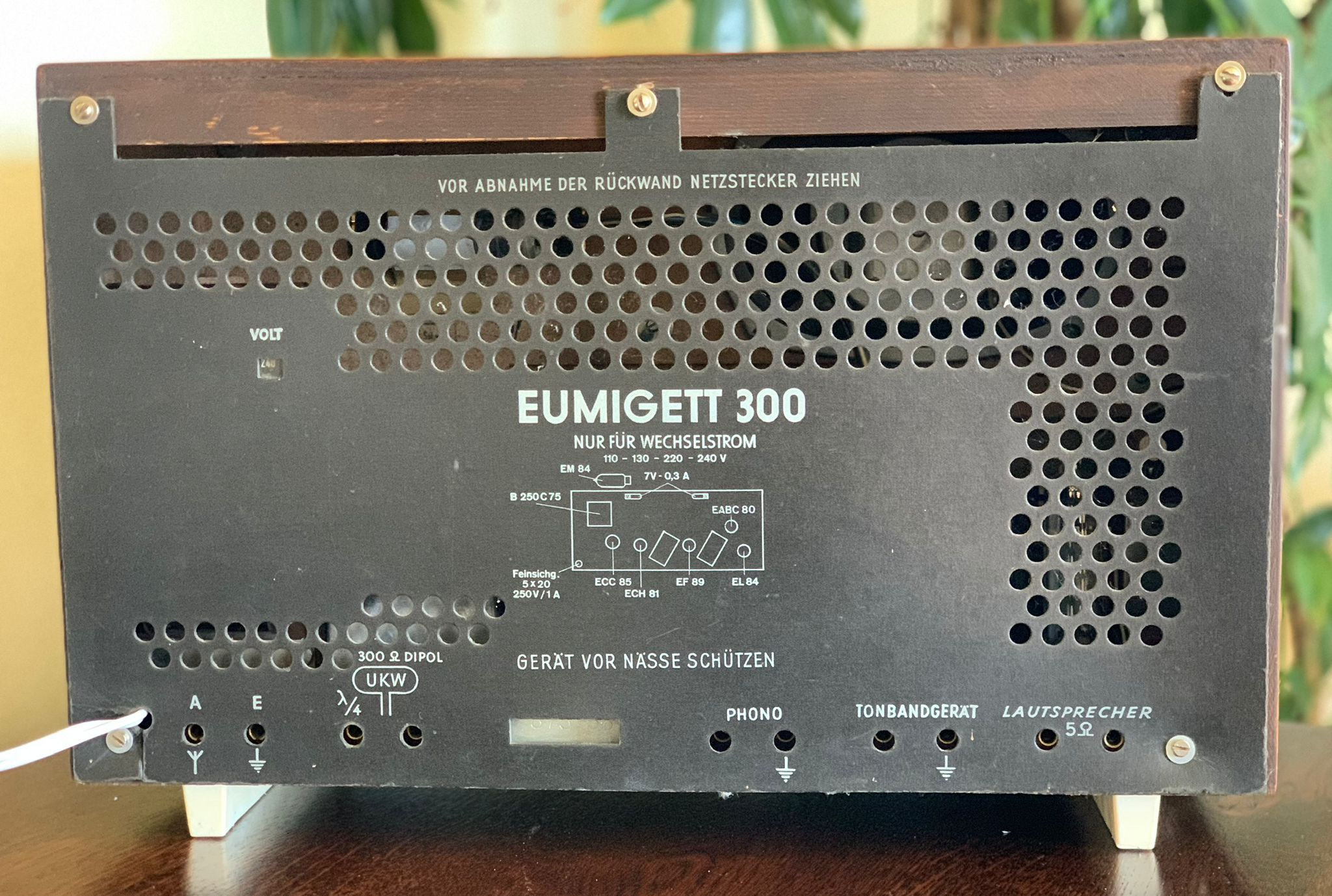
Technically, the Eumigett 300 is a classic superheterodyne receiver for medium wave and FM. The intermediate frequencies are typically given as 457 kHz for AM and 10.4 MHz for FM.
The tube line-up is typical for a radio of this class:
| Tube | Function |
|---|---|
| ECC85 | FM tuner, RF stage and oscillator/mixer |
| ECH81 | AM frequency changer / mixer oscillator |
| EF89 | IF amplifier |
| EABC80 | Detector, demodulator and audio preamplifier |
| EM84 | Tuning indicator, “magic band” |
| EL84 | Audio output stage |
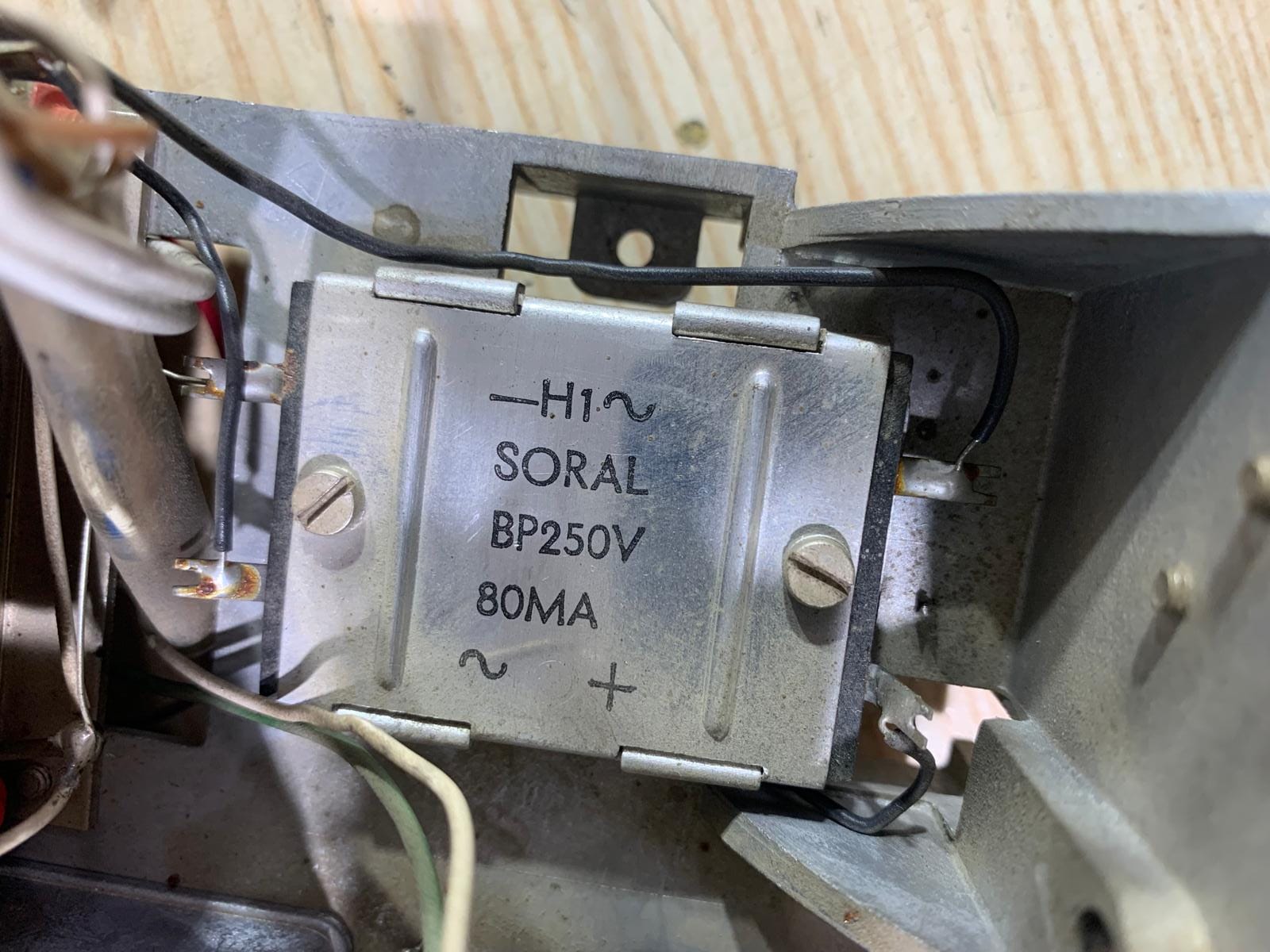
One interesting detail is that the Eumigett 300 no longer uses a tube rectifier. Instead, it uses a selenium rectifier. This places the radio in a transitional period: the receiver is still a true tube radio, but semiconductor technology was already starting to appear in supporting circuit functions.
FM Reception up to 104 MHz
The FM range of the Eumigett 300 extends up to around 104 MHz. This means it does not cover the full modern FM broadcast band up to 108 MHz, but many stations in the lower and middle part of the band can still be received today.
In addition to FM, the set also covers medium wave. Depending on the version, external audio inputs such as phono or tape connections may be available.
Sound and Operation
Like many tube radios of its time, the Eumigett 300 has a warm and pleasant sound. The EL84 output tube provides more than enough audio power for a table radio, and the wooden cabinet helps to give the sound a fuller character than one might expect from a relatively compact set.
The EM84 tuning indicator is one of the most charming visual details. This “magic band” reacts to the strength of the received signal and helps with accurate tuning. Today, it is not only functional, but also one of those details that make operating an old tube radio feel special.
Eumigett 300 vs. Eumigette
Because of the similar name, the Eumigett 300 is easily mistaken for an Eumigette. However, it should not simply be treated as another Eumigette model.
The Eumigett 300 uses a different construction concept. Compared with many older post-war radios, it is more modern internally, including the use of a printed circuit board and a die-cast chassis frame. For a relatively affordable radio, this was quite a solid and forward-looking design.
This makes the Eumigett 300 interesting from a collector’s point of view: it shows Eumig at the point where traditional tube radio technology was being adapted to more modern manufacturing methods.
Variants
There was also a Phono-Eumigett 300 version, which included an integrated record player. This variant was sold as the 388 W Phono-Eumigett 300 and combined the radio chassis with a multi-speed record player.
These radio-phono combinations were very typical for the period. They were intended as compact home entertainment units, offering radio reception and record playback in one piece of furniture.
Conclusion
The Eumigett 300 is not a large luxury receiver, but it is a very interesting Austrian tube radio from the last phase of Eumig’s radio production. It combines classic tube circuitry with more modern construction techniques such as a printed circuit board, a selenium rectifier and a die-cast chassis.
This is exactly what makes the set appealing. It is still clearly a tube radio, with all the charm that comes with glowing valves, a magic tuning indicator and a wooden cabinet. At the same time, it already shows how radio manufacturing was changing in the early 1960s.
The Eumigett 300 is therefore more than just a nice old radio. It is a small but fascinating piece of Austrian radio history.
Technical Summary
| Feature | Eumig Eumigett 300 |
|---|---|
| Manufacturer | Eumig, Vienna, Austria |
| Production period | 1961 |
| Type | Tube superheterodyne receiver |
| Wavebands | Medium wave, FM |
| FM range | Up to approx. 104 MHz |
| Tubes | ECC85, ECH81, EF89, EABC80, EM84, EL84 |
| Rectifier | Metal rectifier |
| Intermediate frequencies | 457 kHz / 10.4 MHz |
| Loudspeaker | Oval permanent-magnet loudspeaker |
| Cabinet | Wooden cabinet |
| Special features | Printed circuit board, die-cast chassis, EM84 magic tuning indicator |
References and Further Reading
- Radiomuseum.org – Eumigett 300 387W
- Saintummers – Eumigett 300 restoration project
- eumigMuseum – Eumig radios, TV and tape recorders
Service Manual and Circuit Diagram
Pictures
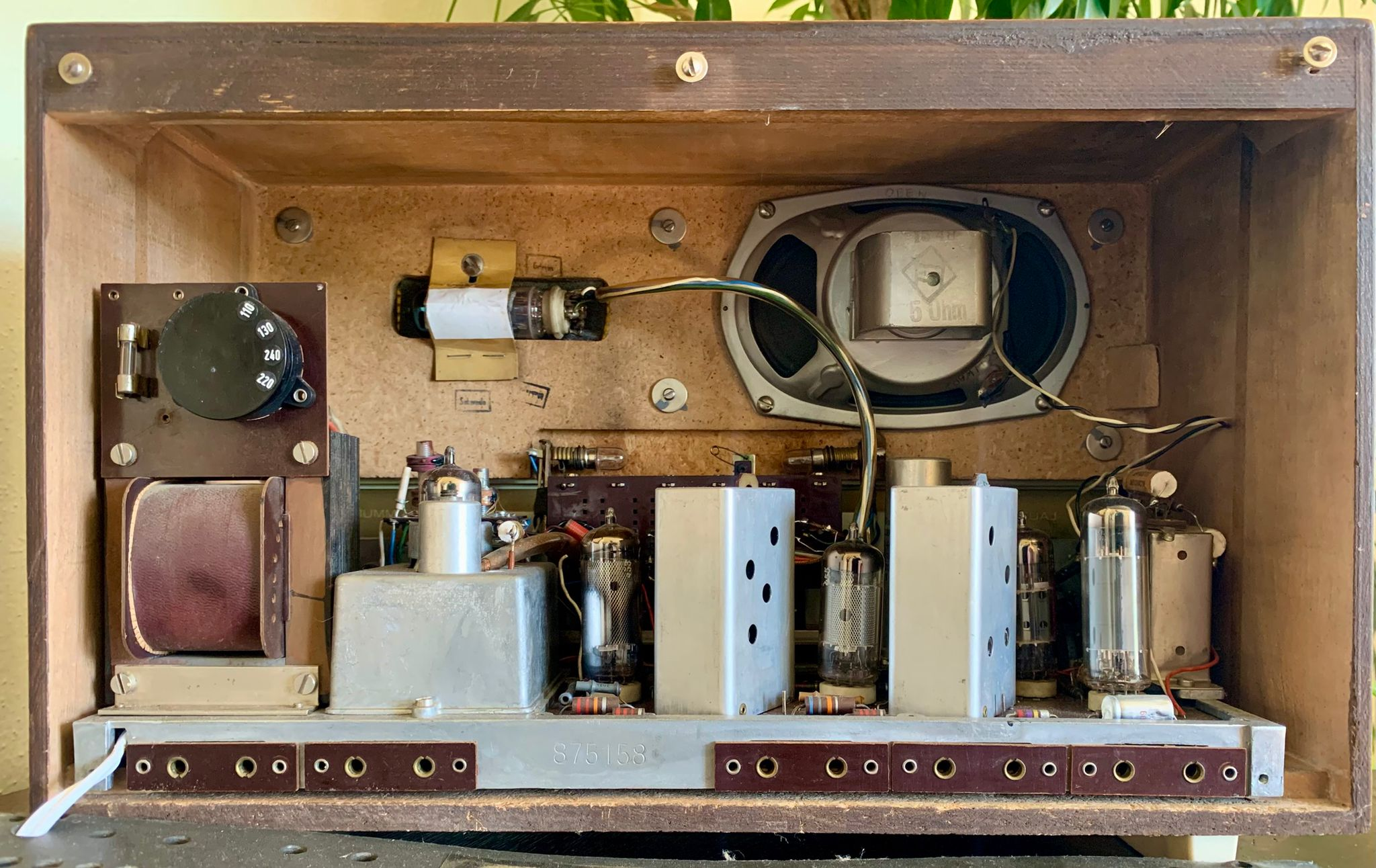
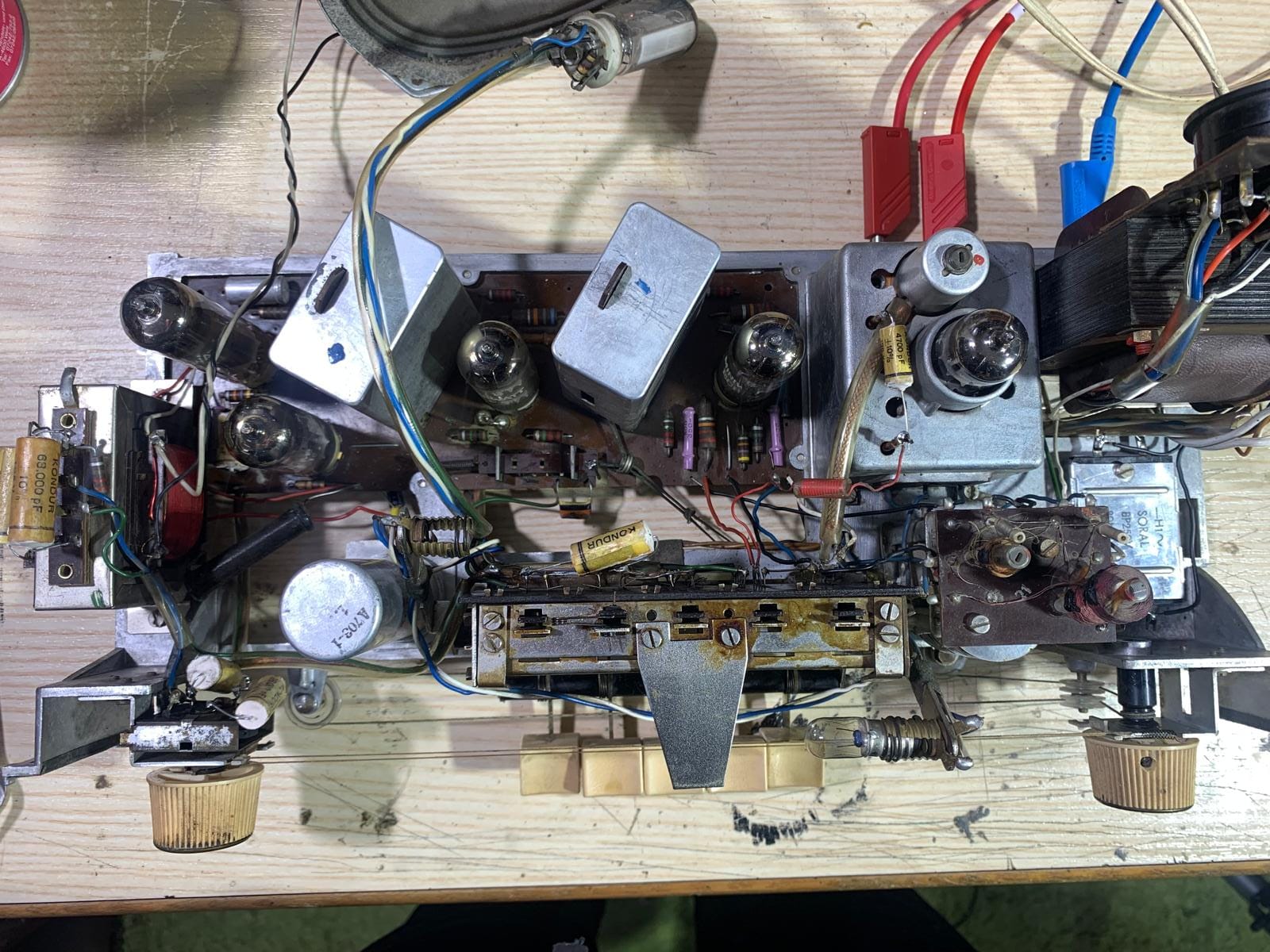
The original selenium rectifier housing was reused. Its internal components were removed and replaced with a MOSFET-based rectifier replacement circuit inspired by https://www.radiomuseum.org/forum/selengleichrichter_ersatz_durch_mosfet_schaltung.html
Already receiving stations, but still in need of cleaning
Restoration Notes
This Eumigett 300 was restored with the aim of keeping the chassis visually as original as possible while replacing electrically critical ageing components.
The cabinet and chassis were cleaned inside and outside, the push-button switch contacts were cleaned, a new mains cable was fitted, and the EM84 magic eye tube was replaced.
All paper capacitors were carefully opened and rebuilt internally with modern film capacitors. The original outer sleeves and labels were preserved, and the capacitors were sealed again after rebuilding. The electrolytic capacitors were treated in the same way: the original cans were retained, but their internal contents were replaced with modern electrolytic capacitors.
The original selenium rectifier was replaced as well. Its housing was reused and fitted with a modern replacement circuit, preserving the original look while improving reliability and safety.
The result is a radio that still looks authentic when viewed from inside the chassis, but is electrically much more reliable for occasional operation.
White House Audio Collection. Remarks at the Airport in Vienna Upon Leaving for London, England, 4 June 1961