Hornyphon Hornyst W 445 A
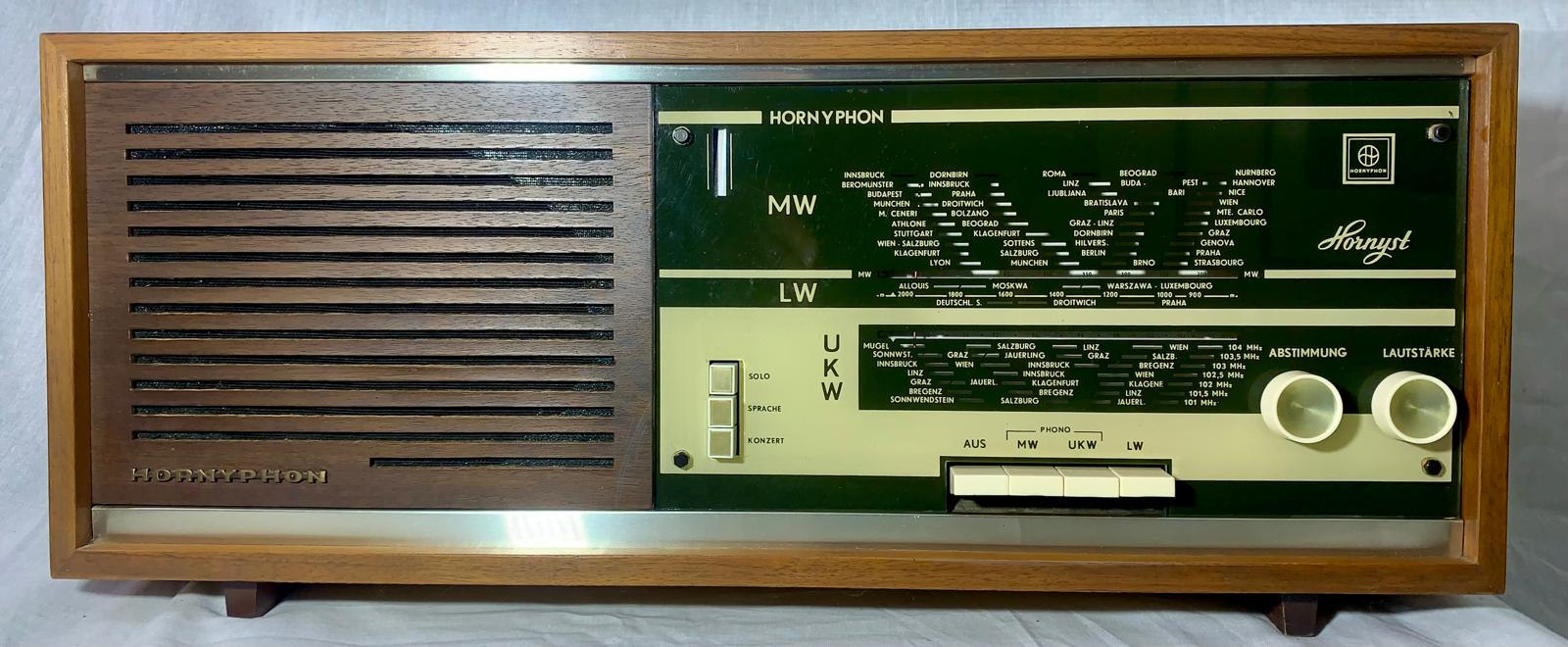
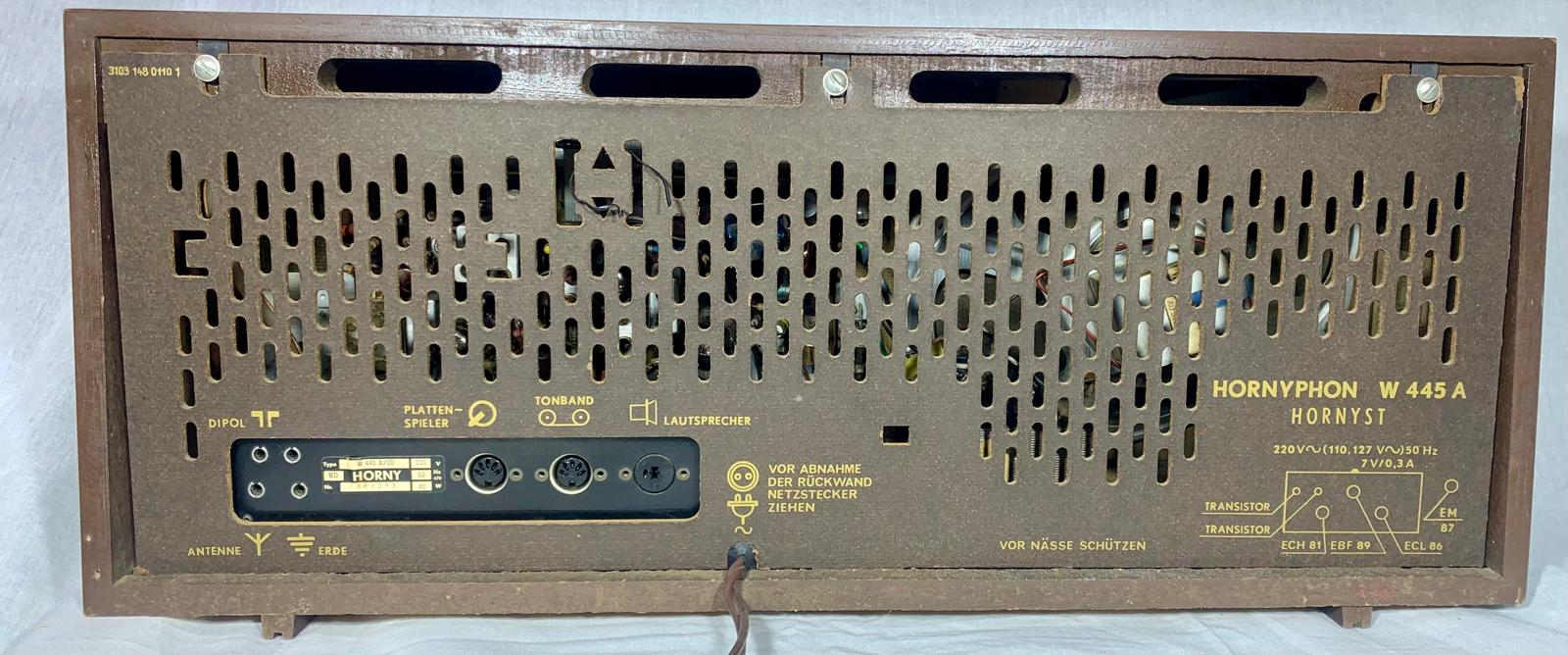
The Hornyphon Hornyst W 445 A is an Austrian table radio from the mid-1960s, built at a time when traditional valve radio technology was already approaching the end of its domestic era. According to available model data, the Hornyst W 445 A dates from around 1965/66 and was offered in two cabinet versions, a dark version /00 and a lighter version /70.
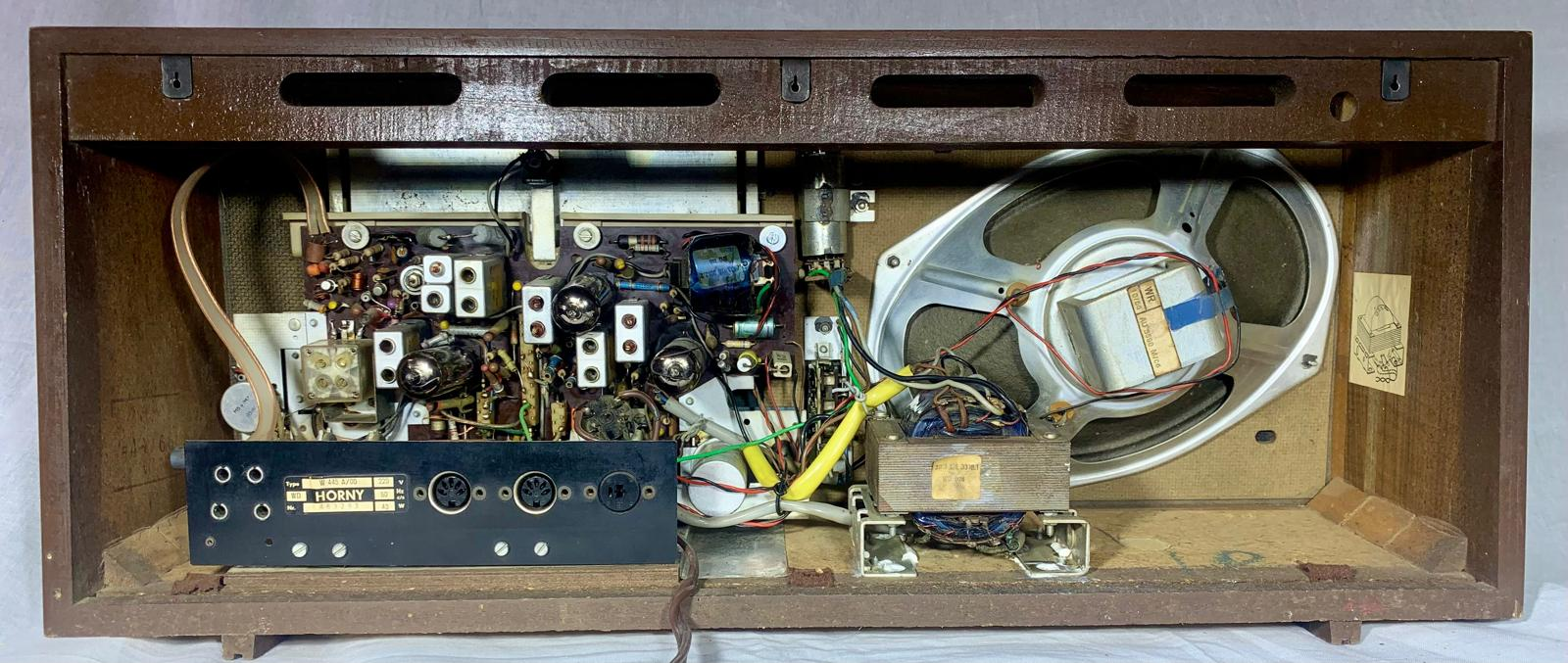
Although it still uses classic radio valves, the set already shows the transitional character of the 1960s. The circuit combines valves such as ECH81, EBF89, ECL86 and EM87 with early semiconductor components, including AF124 and AF125 transistors. This makes the Hornyst W 445 A an interesting example from the late period of Austrian valve-radio production.
The receiver covers long wave, medium wave and FM, making it a typical European domestic radio of its time. The FM intermediate frequency is listed as 10.7 MHz, while the AM intermediate frequency is given as 460 kHz. The set is housed in a wooden cabinet and has a relatively low, wide table-radio shape with push buttons on the front. Its dimensions are approximately 560 × 210 × 180 mm.
Technical Overview
| Item | Description |
|---|---|
| Manufacturer | Hornyphon, Vienna, Austria |
| Model | Hornyst W 445 A |
| Year | Around 1965/66 |
| Type | Table radio |
| Cabinet | Wooden case |
| Wavebands | Long wave, medium wave, FM |
| Circuit | Superheterodyne receiver |
| Valves | ECH81, EBF89, ECL86, EM87 |
| Semiconductors | AF124, AF125 |
| IF Frequencies | 460 kHz / 10.7 MHz |
| Dimensions | Approx. 560 × 210 × 180 mm |
| Power Supply | AC mains, 110–240 V |
Design and Historical Context
By the mid-1960s, the radio market had already changed considerably. Transistor radios were becoming more common, television had become an important part of home entertainment, and large wooden table radios were slowly disappearing from everyday living rooms. The Hornyst W 445 A belongs to this final generation of domestic valve receivers.
Its design is simpler and more compact than the large multi-speaker radios of the 1950s, but it still keeps the familiar appearance of a classic European home radio: wooden cabinet, front speaker grille, illuminated scale, push-button band selection and a magic eye tuning indicator. The EM87 magic eye gives the radio the characteristic green tuning display that was still popular in higher-quality sets of this period.
The use of both valves and semiconductors reflects the technical transition of the time. Instead of being a purely valve-based receiver, the Hornyst W 445 A already includes transistor technology while still retaining the warm-up behaviour and operating feel of a tube radio. For this reason, it is a nice example of the bridge between the classic valve-radio era and the fully transistorized radios that followed.
Restoration Notes
This Hornyphon Hornyst W 445 A was cleaned both inside and outside. The mains capacitor was rebuilt by opening the original capacitor body, installing a modern replacement inside, and closing it again in order to preserve the original appearance.
The ratio detector electrolytic capacitor was also replaced, as this component is important for proper FM reception and can cause distortion or unstable sound when aged.
Overall, the restoration was limited to careful cleaning and the replacement or rebuilding of a few important age-related components, while keeping the chassis appearance as original as possible.
User Manual
References
- Radiomuseum.org – Hornyst W445A /00 /70
- Doctsf – Hornyphon Hornyst W 445 A
- Radiomuseum.org – Hornyphon model catalogue listing, including Hornyst W445A
Pictures