Loewe Opta Ratsherr Type 1553 W
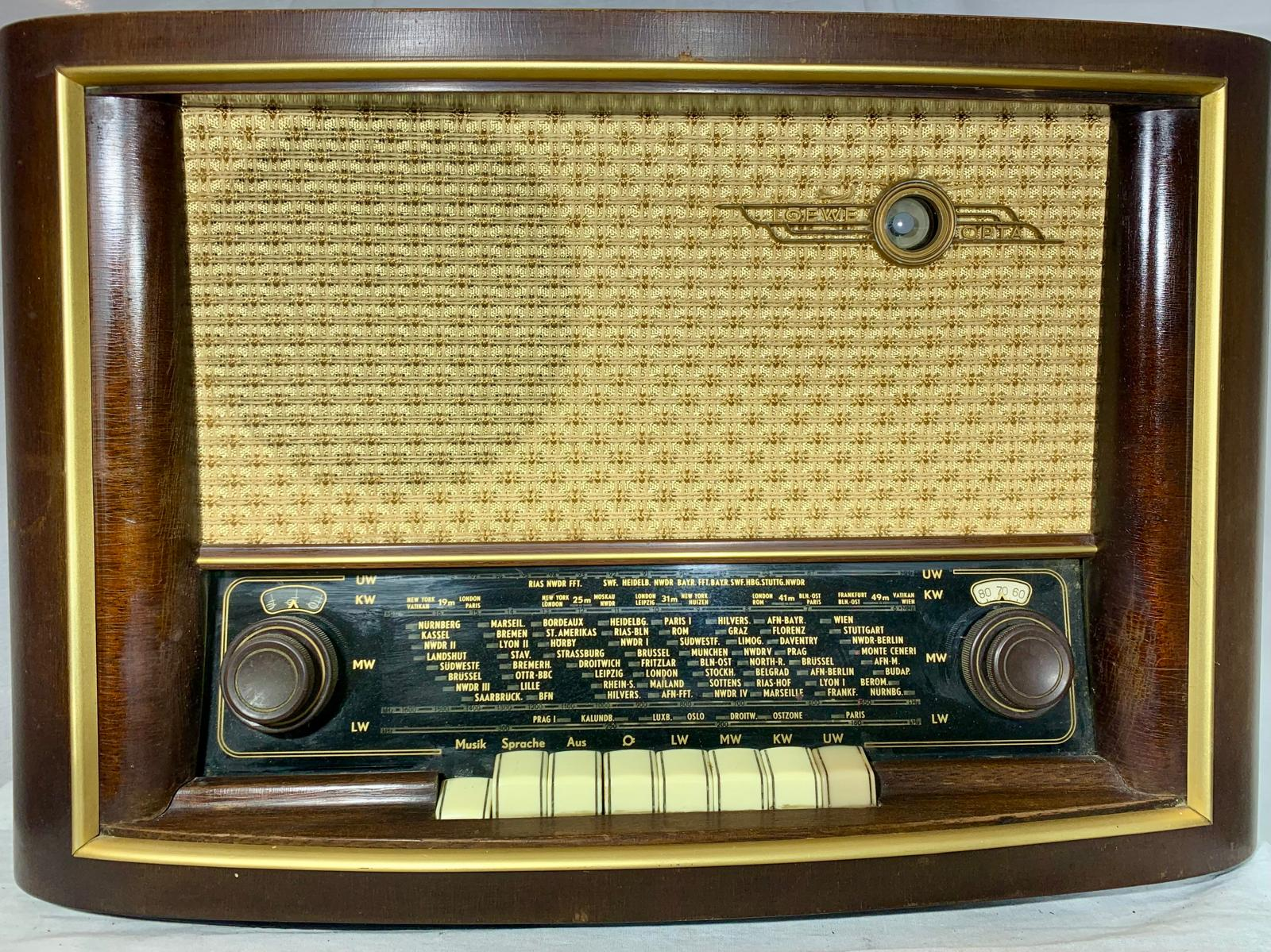
The Loewe Opta Ratsherr Type 1553 W is a German table radio from the early 1950s, produced during the period when FM broadcasting was becoming an increasingly important feature in European domestic receivers. The model dates from 1952/1953 and represents the more ambitious class of post-war German radios: a large wooden cabinet, push-button waveband selection, long-wave, medium-wave, short-wave and FM reception, and a tuning eye for visual tuning indication.
Loewe Opta was one of the important German radio and television manufacturers of the 20th century. The company traces its origins back to 1923, when the brothers Siegmund and David Ludwig Loewe founded a radio company in Berlin, at almost the same time as regular broadcasting began in Germany. Loewe soon became known not only for domestic radio receivers, but also for technical innovation. Together with the young inventor Manfred von Ardenne, Loewe was involved in early work on multi-system tubes and electronic television. In 1931, electronic television was demonstrated to the public at the Loewe stand at the Berlin Radio Exhibition. After the Second World War, Loewe Opta continued as a West German manufacturer, with production in Kronach, Bavaria, and became known for well-built radios and later television sets.
The name “Ratsherr” gives the set a rather dignified character. Like many larger German radios of this period, it was not only intended as a technical appliance but also as a piece of living-room furniture. The wide dial glass, the substantial wooden cabinet and the 20 cm loudspeaker give the radio the appearance of a serious, high-quality domestic receiver.
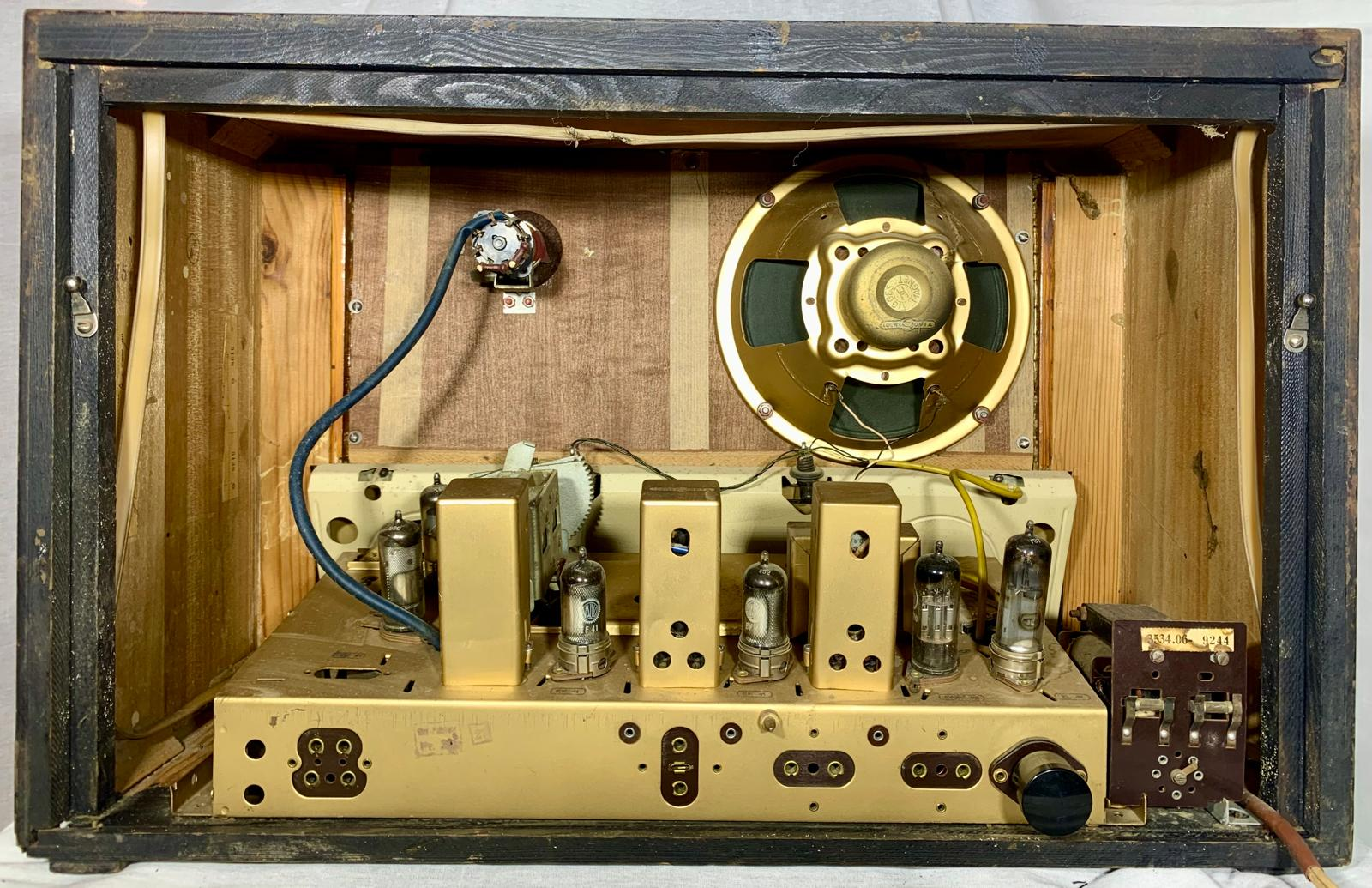
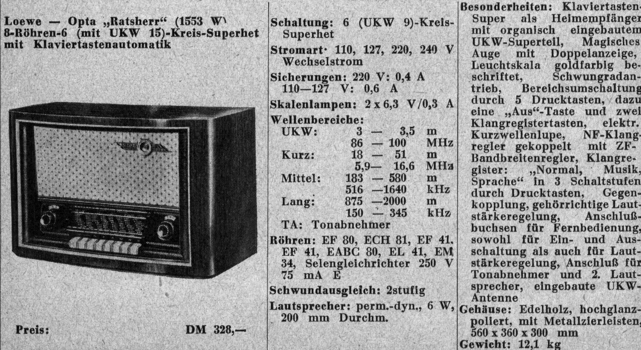
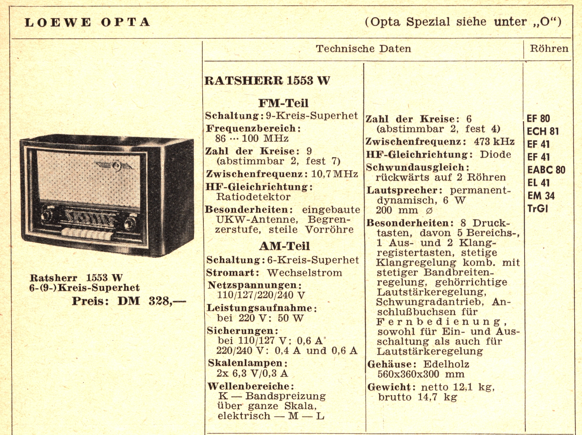
Technically, the Ratsherr 1553 W is a superheterodyne receiver with separate AM and FM intermediate frequencies. The documented tube line-up is EF80, ECH81, EF41, EF41, EM34, EABC80 and EL41, together with a selenium dry rectifier. The set has 6 AM circuits and 9 FM circuits, as well as a variable bandwidth and short-wave fine tuning, described in German as “Bandbreite regelbar” and “KW-Lupe”.
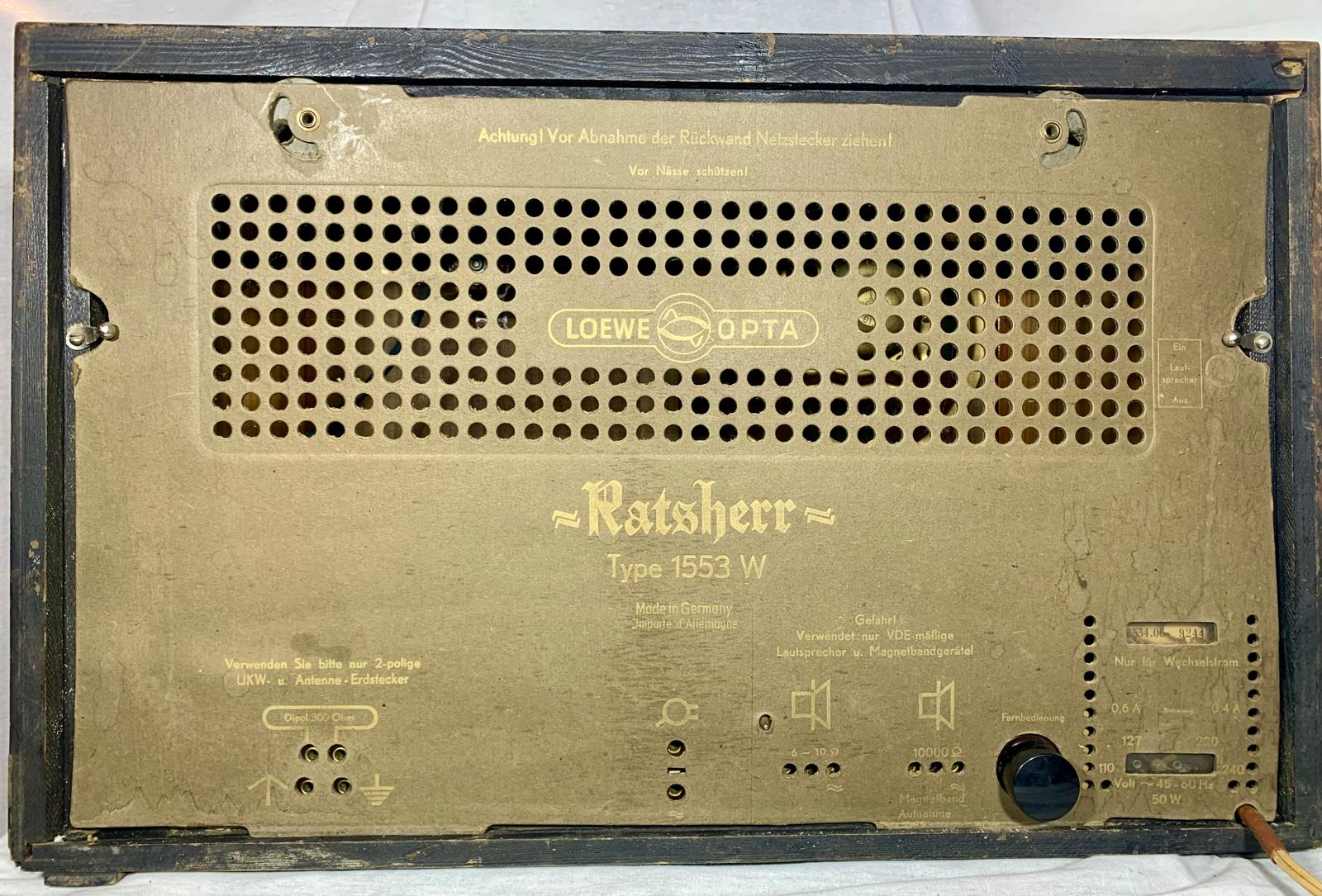
A notable feature of this Loewe Opta Ratsherr Type 1553 W is the provision for a wired remote control. This was a rather advanced convenience feature for a domestic radio of the early 1950s. It allowed certain operating functions — typically volume control or similar basic adjustments, depending on the accessory used — to be controlled from a distance without having to access the radio directly.
This detail underlines the higher-class character of the Ratsherr model. The set was not only designed as a powerful broadcast receiver, but also as a comfortable living-room radio with features aimed at more convenient everyday use.
Condition
This Loewe Opta Ratsherr Type 1553 W is preserved in unrestored condition, exactly as acquired. No electrical or cosmetic restoration has yet been carried out.
Technical Data
| Item | Data |
|---|---|
| Manufacturer | Loewe Opta, Germany |
| Model | Ratsherr Type 1553 W |
| Year | 1952/1953 |
| Type | Table radio with push buttons |
| Circuit principle | Superheterodyne |
| Wavebands | Long Wave, Medium Wave, Short Wave, FM / UKW |
| IF frequencies | 473 kHz / 10.7 MHz |
| Tubes | EF80, ECH81, EF41, EF41, EM34, EABC80, EL41 |
| Rectifier | Selenium dry rectifier, listed as E250C75 |
| Loudspeaker | Permanent magnet dynamic loudspeaker, approx. 20 cm |
| Cabinet | Wooden case |
| Dimensions | approx. 560 × 360 × 300 mm |
| Weight | approx. 12.1 kg |
| Original price | 328 DM |
Circuit Diagram
References and Further Reading
Pictures