Philips Sonate BA581A – Austrian Post-War Table Radio from 1948
The Philips Sonate BA581A is an Austrian-built valve radio from the immediate post-war period. It was produced by Philips Austria around 1948–1950 and represents the type of well-built AM table receiver that was common before FM broadcasting became standard in domestic radios.
Although it carries the Philips name, the Sonate BA581A is also closely connected with the Austrian Hornyphon production line. Contemporary collector references list it as the Philips counterpart of the Hornyphon Maestro W 548 A/U. This was not unusual: for many Hornyphon sets there were corresponding Philips and Zerdik models, often using the same chassis while differing mainly in cabinet design and external appearance.
The result is a technically solid late-1940s Austrian radio in a wooden cabinet, equipped for long wave, medium wave and several short-wave bands. Its large dial, magic-eye tuning indicator and traditional wooden case give it the typical appearance of a high-quality European domestic receiver of its time.
Technical Overview
| Feature | Details |
|---|---|
| Manufacturer | Philips Austria |
| Model | Sonate BA581A |
| Year | 1948–1950 |
| Type | Valve table radio |
| Circuit principle | AM superheterodyne receiver |
| Wavebands | Long wave, medium wave and short wave |
| Valves / Tubes | ECH4, ECH4, EBL1, AZ1, UM4 |
| Tuning indicator | UM4 magic eye |
| Loudspeaker | Permanent-magnet dynamic loudspeaker |
| Power supply | AC mains |
| Cabinet | Wooden table cabinet |
| Original price | approx. 2,250 Austrian Schilling |
Historical Context
The Sonate BA581A belongs to the early post-war generation of Austrian radio receivers. In this period, manufacturers often reused proven circuit concepts and existing valve types while gradually returning to normal civilian production.
The tube line-up still uses older side-contact valves such as the ECH4 and EBL1, which were common in European radios before the later all-glass miniature valve series became dominant. The set is therefore technically rooted in pre-war and immediate post-war radio design, but presented in a refined domestic cabinet suitable for the late 1940s living room.
The connection to the Hornyphon Maestro W 548 A/U is especially interesting. It shows how closely related some Austrian Philips, Hornyphon and Zerdik models were. The chassis could be largely identical, while the visible identity of the radio was created through the cabinet, dial, trim and brand presentation.
Design and Cabinet
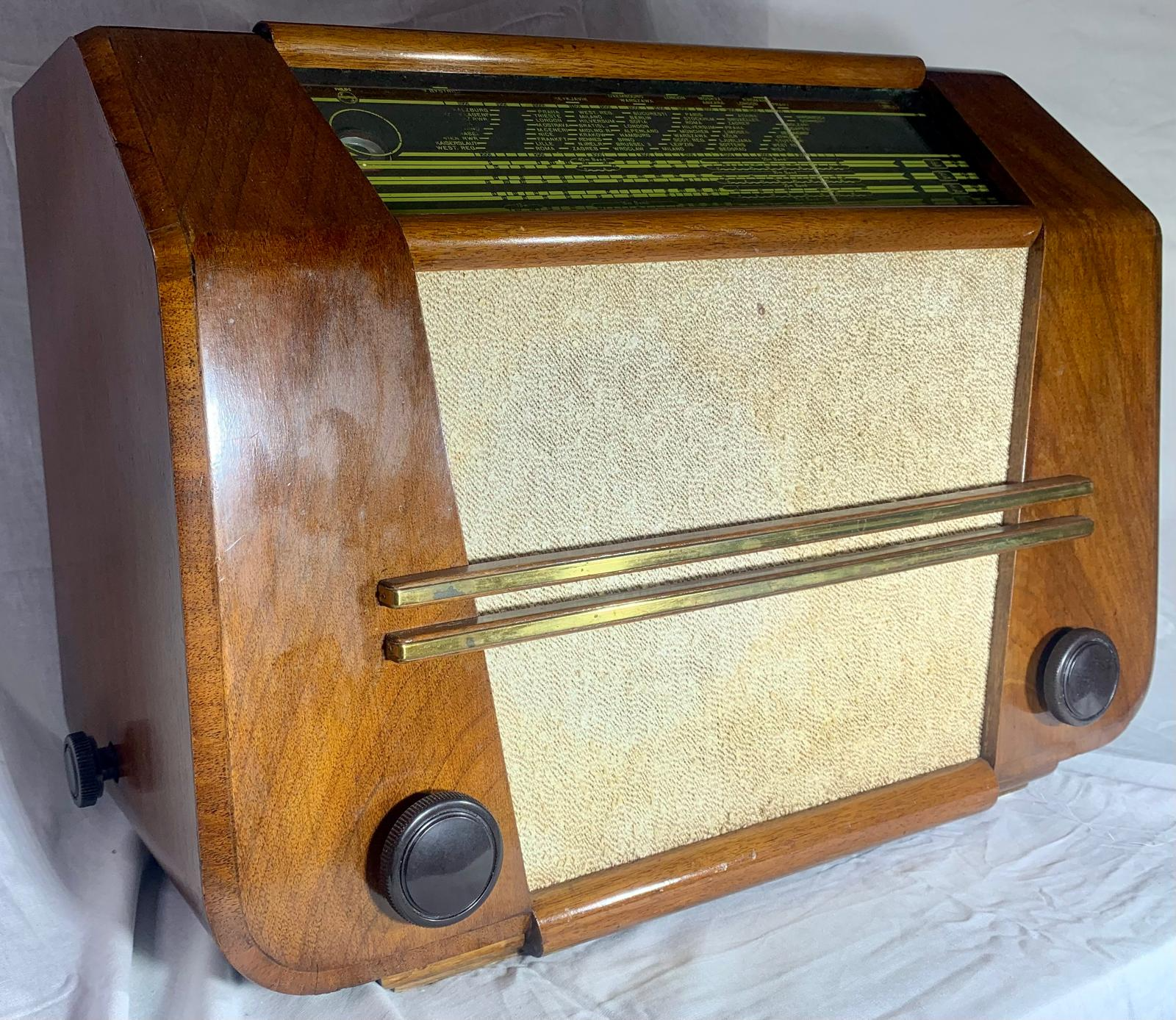
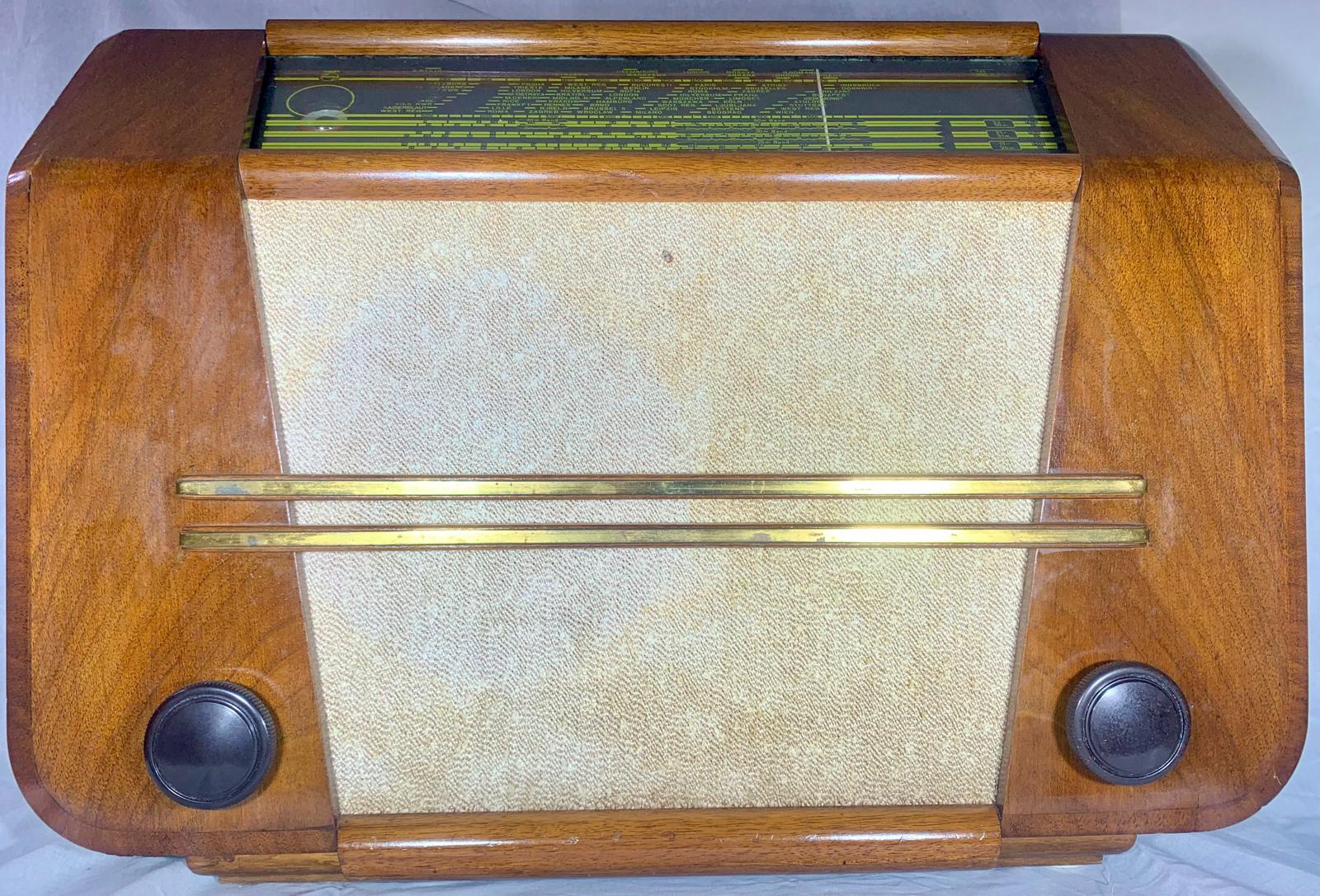
The Philips Sonate BA581A is a large wooden table radio with a classic horizontal layout. The front is dominated by the speaker opening and the dial scale, with the controls arranged in the traditional way for this period.
The wooden cabinet gives the radio a warmer and more domestic appearance than bakelite sets of the same era. It was clearly intended as a piece of household furniture as much as a radio receiver. After restoration, the refreshed wood finish and the carefully cleaned original speaker cloth once again emphasize this character.
Reception and Use
The Sonate BA581A is an AM-only receiver. It covers long wave, medium wave and several short-wave ranges. There is no FM band, which is typical for a European domestic radio of this immediate post-war generation.
With a suitable antenna, such radios can still be used to receive medium-wave or short-wave signals, depending on local conditions. Alternatively, they can be operated together with a small AM transmitter. This allows modern audio sources to be played through the original radio circuit without modifying the historical electronics.
Restoration Note
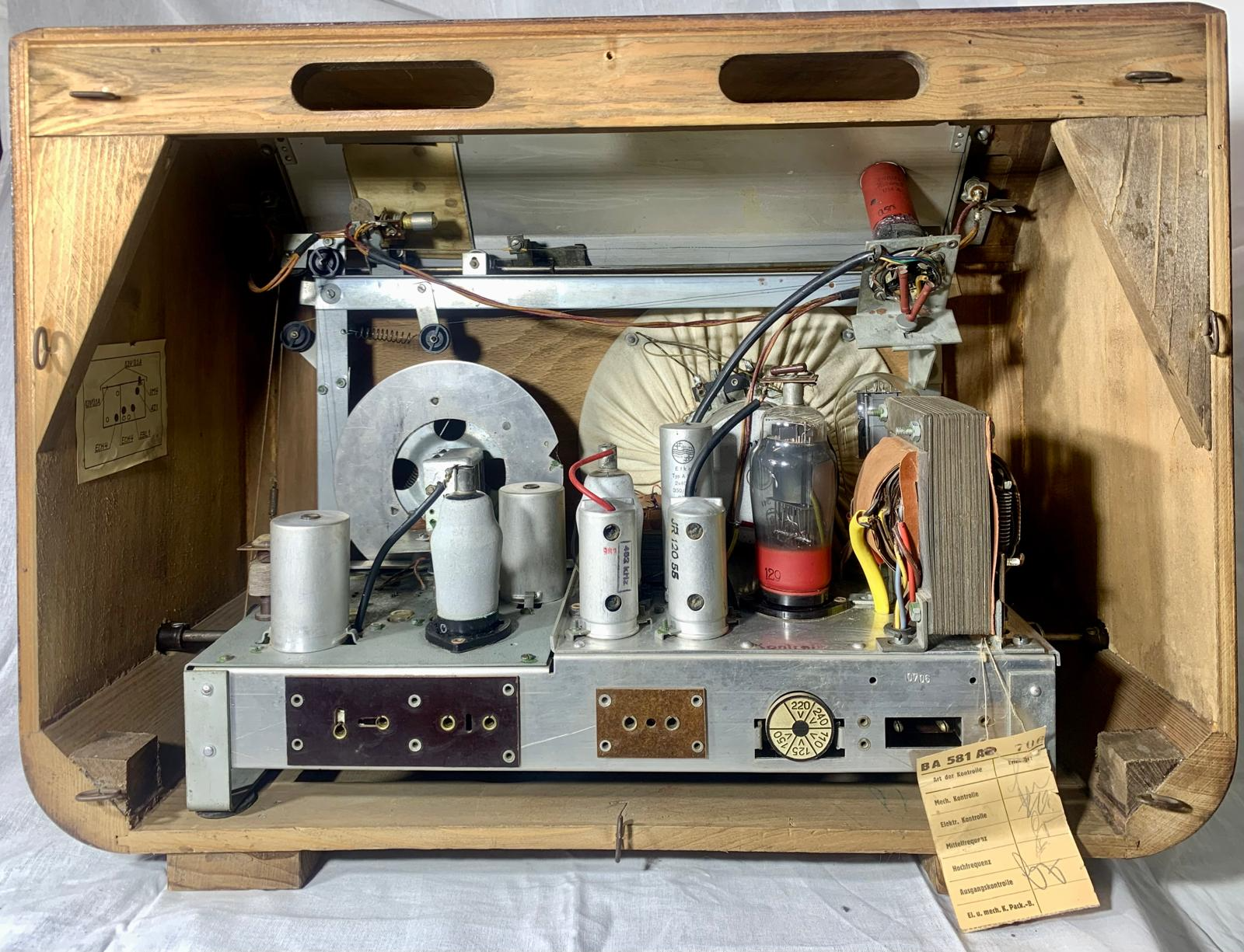
This Philips Sonate BA581A was carefully cleaned inside and out. The chassis, controls and tube sockets were inspected and cleaned, and the interior was freed from dust and dirt accumulated over many decades.
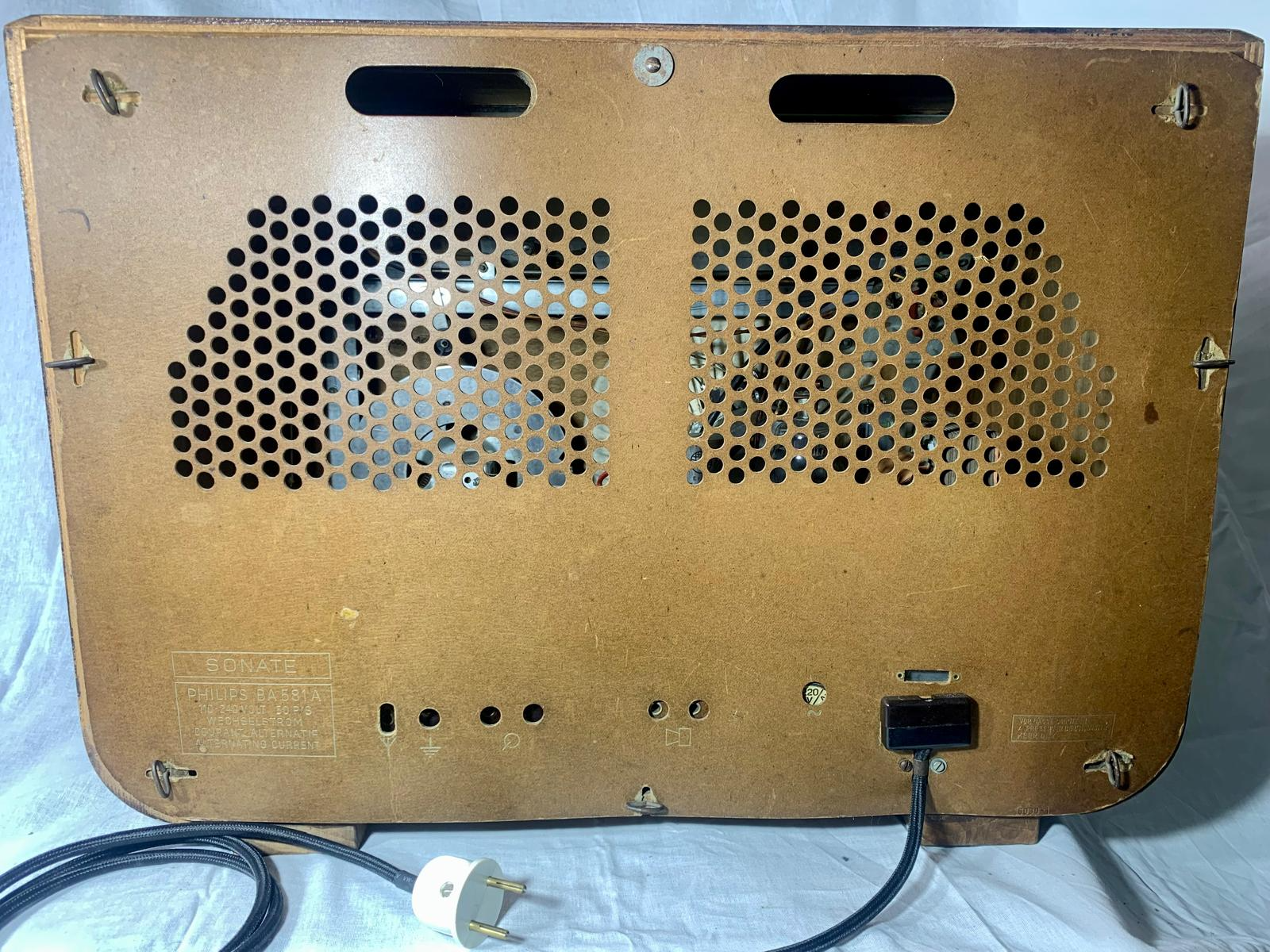
As with the other restored sets, the aged electrolytic and paper capacitors were not simply replaced visibly. Instead, the original capacitor bodies were opened, fitted with modern components inside, and carefully closed again. This preserves the original appearance of the chassis while improving electrical reliability.
A new mains cable was fitted for safer operation. The dial lamps were replaced, restoring the illumination of the scale.
The wooden cabinet was refinished externally with several layers of hard oil. This gives the surface a renewed, protected finish while keeping the natural appearance of the wood.
Final Impression
The Philips Sonate BA581A is a good example of Austrian post-war radio production: technically conservative, solidly built and visually elegant. Its relationship to the Hornyphon Maestro W 548 A/U makes it especially interesting from a collector’s point of view, because it shows how different brand identities could be built around closely related technical platforms.
After cleaning, electrical restoration, cabinet refinishing and cleaning of the speaker cloth and dial lamps, this set again presents itself as a fine late-1940s Austrian table radio.
References and Further Reading
Pictures