Terta Type T325 – Hungarian Valve Radio from the Mid-1950s
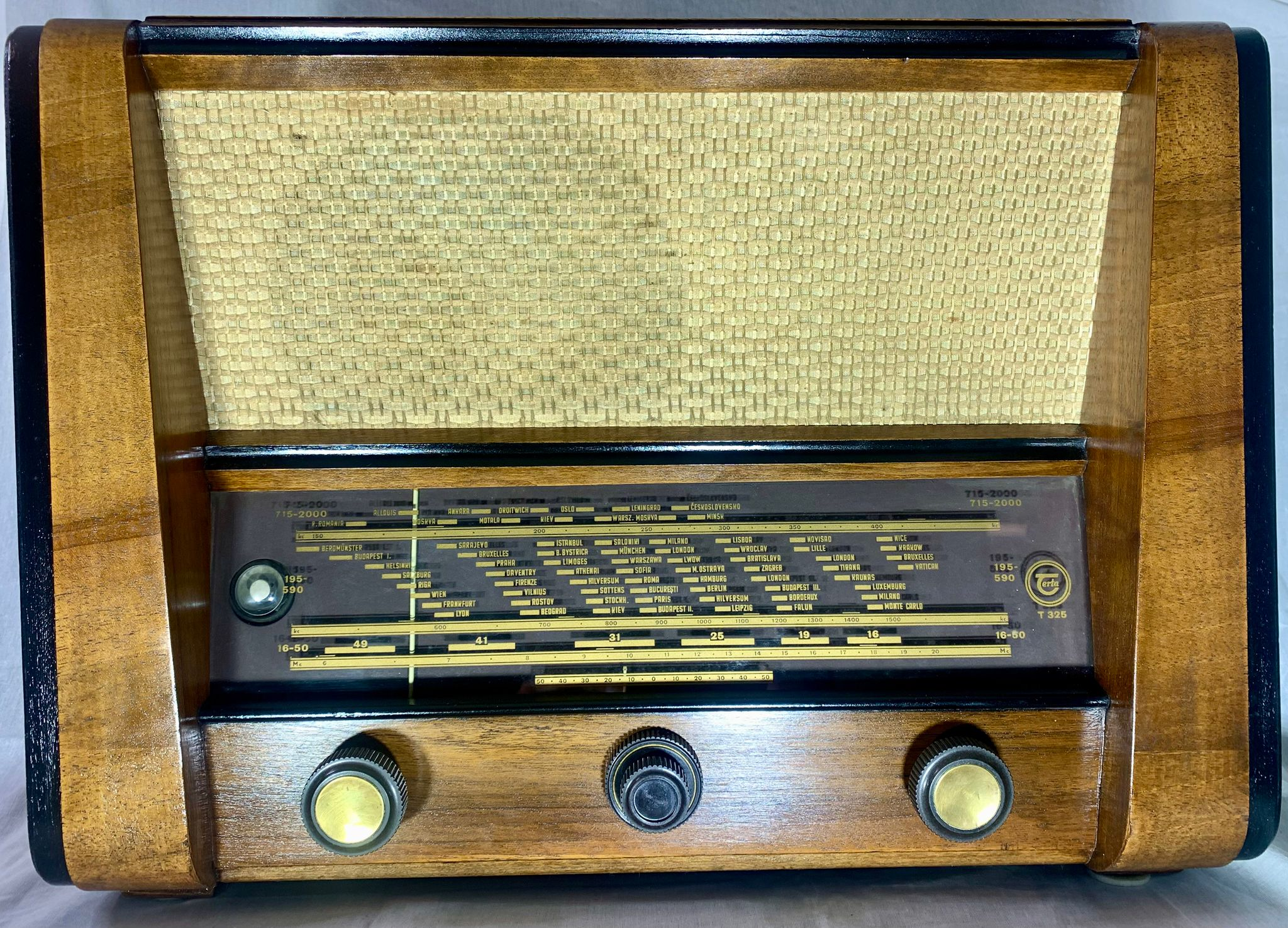
The Terta Type T325 is a large Hungarian table radio produced by Telefongyár in Budapest, better known under the brand name Terta. The set dates from the mid-1950s, with Hungarian sources listing production around 1955–1957. It belongs to the generation of post-war European valve radios intended for Long Wave, Medium Wave and Short Wave reception, before FM became common in many domestic receivers.
Telefongyár was one of Hungary’s important communications-equipment manufacturers. Its history goes back to the late 19th century, and its main field was telephone and telecommunications equipment. Radio production formed only part of a much broader industrial activity. Hungarian radio-museum sources describe Telefongyár as one of the early centres of institutional radio manufacturing in Hungary, with civilian radio receiver production beginning in the 1920s. After the Second World War, radio production was resumed in the 1950s, partly based on Orion models.
A Solid Post-War Table Receiver
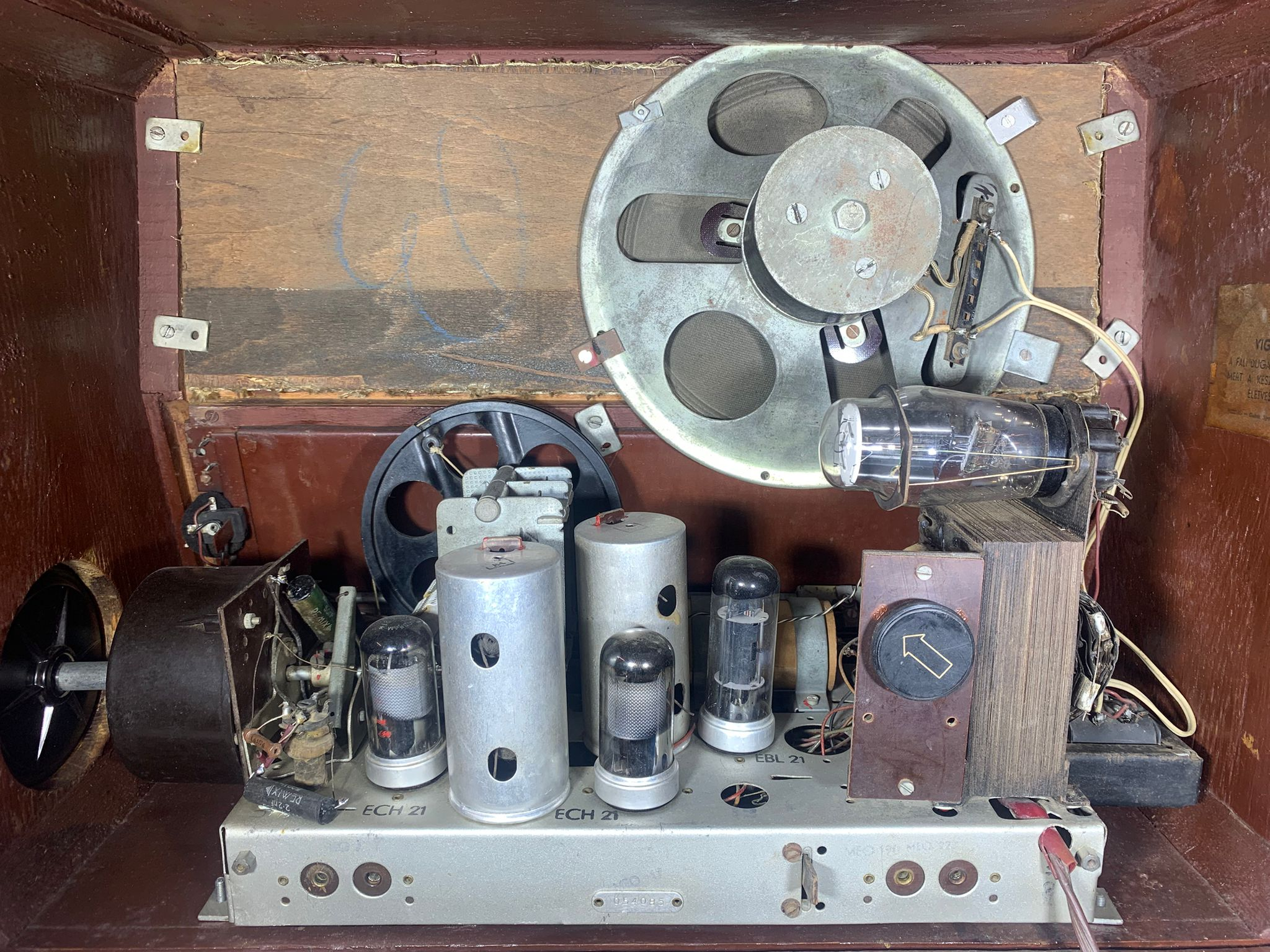
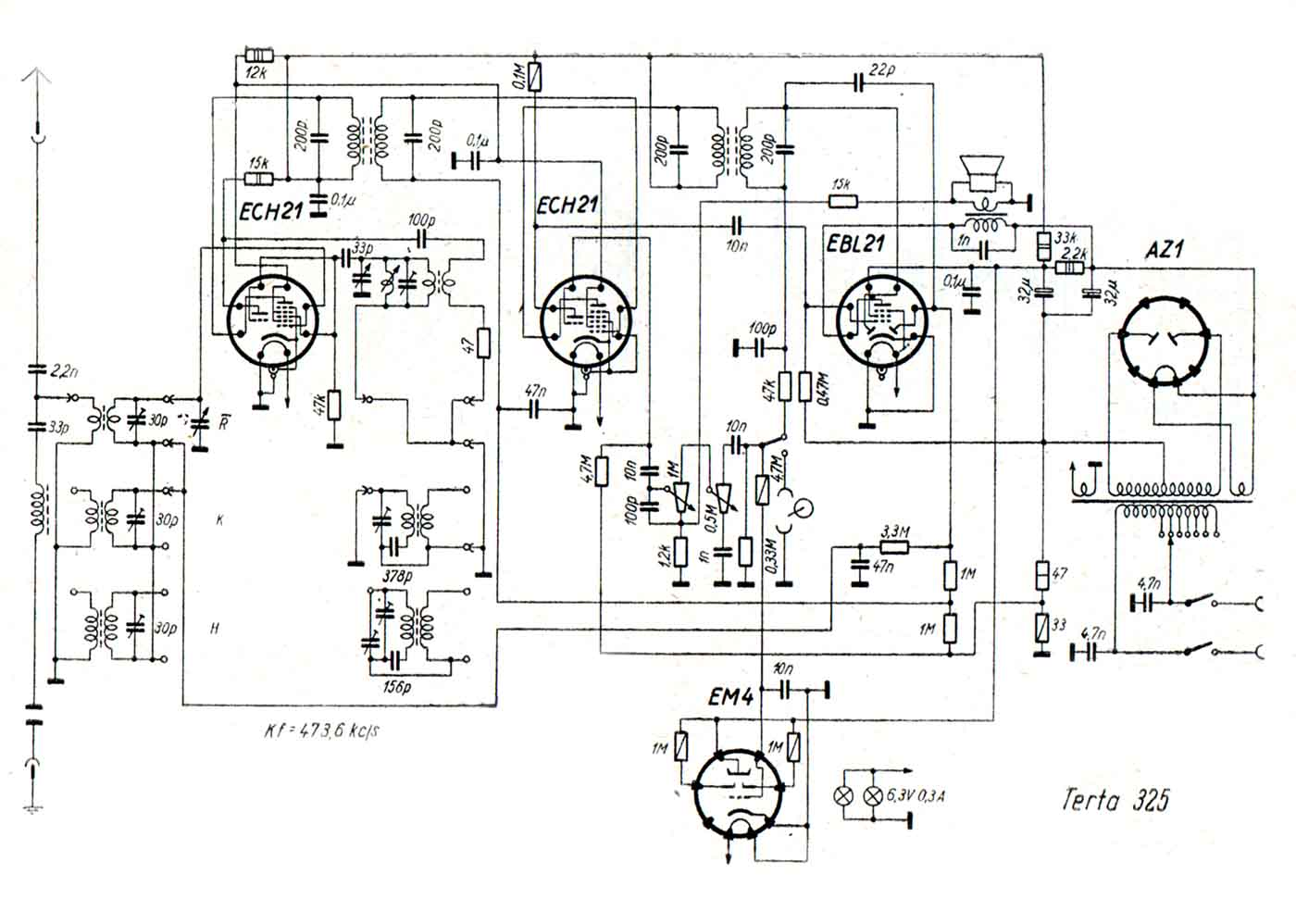
The T325 is a mains-operated superheterodyne receiver in a polished wooden cabinet. It uses a conventional mid-1950s valve line-up with 2 × ECH21, EBL21, AZ1 and EM4. The EM4 tuning indicator gives the set the typical “magic eye” feature, which was still an attractive and useful detail on domestic radios of this period. Radiomuseum lists the intermediate frequency as about 473.6 kHz, with a permanent-magnet dynamic loudspeaker of about 20 cm diameter and an output power of approximately 2.5 W.
Unlike later receivers, the T325 has no VHF/FM section. Its wavebands are the classic AM broadcast ranges:
- Long Wave
- Medium Wave
- Short Wave
For today’s use, this makes the set especially suitable for reception with a good external antenna, or for demonstration with a small AM transmitter.
Design and Details
The radio is a wide, low-profile table set with a wooden cabinet and a large speaker opening at the front. The design is rather restrained and practical, but still has the warm appearance typical of 1950s wooden radios.
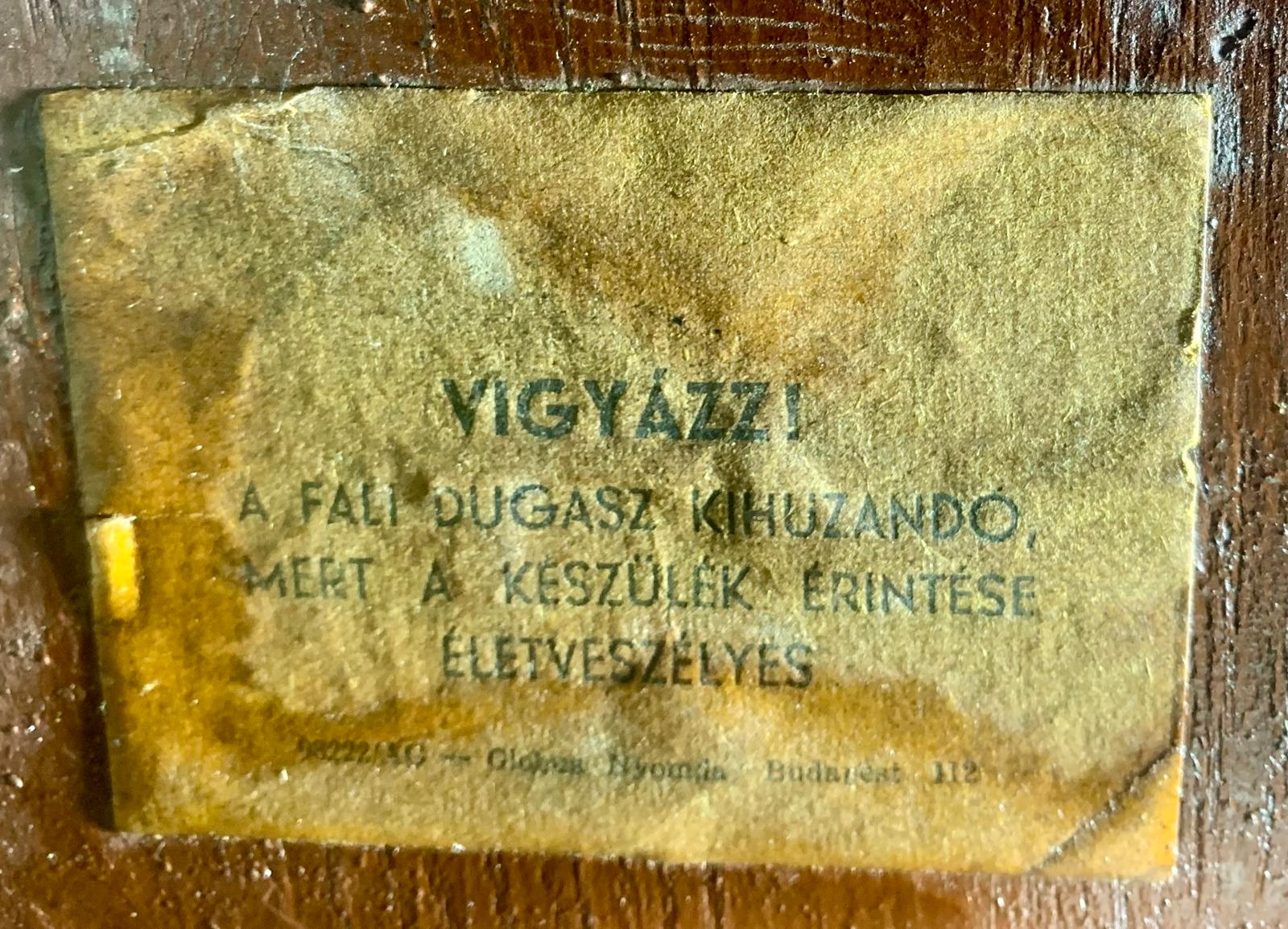
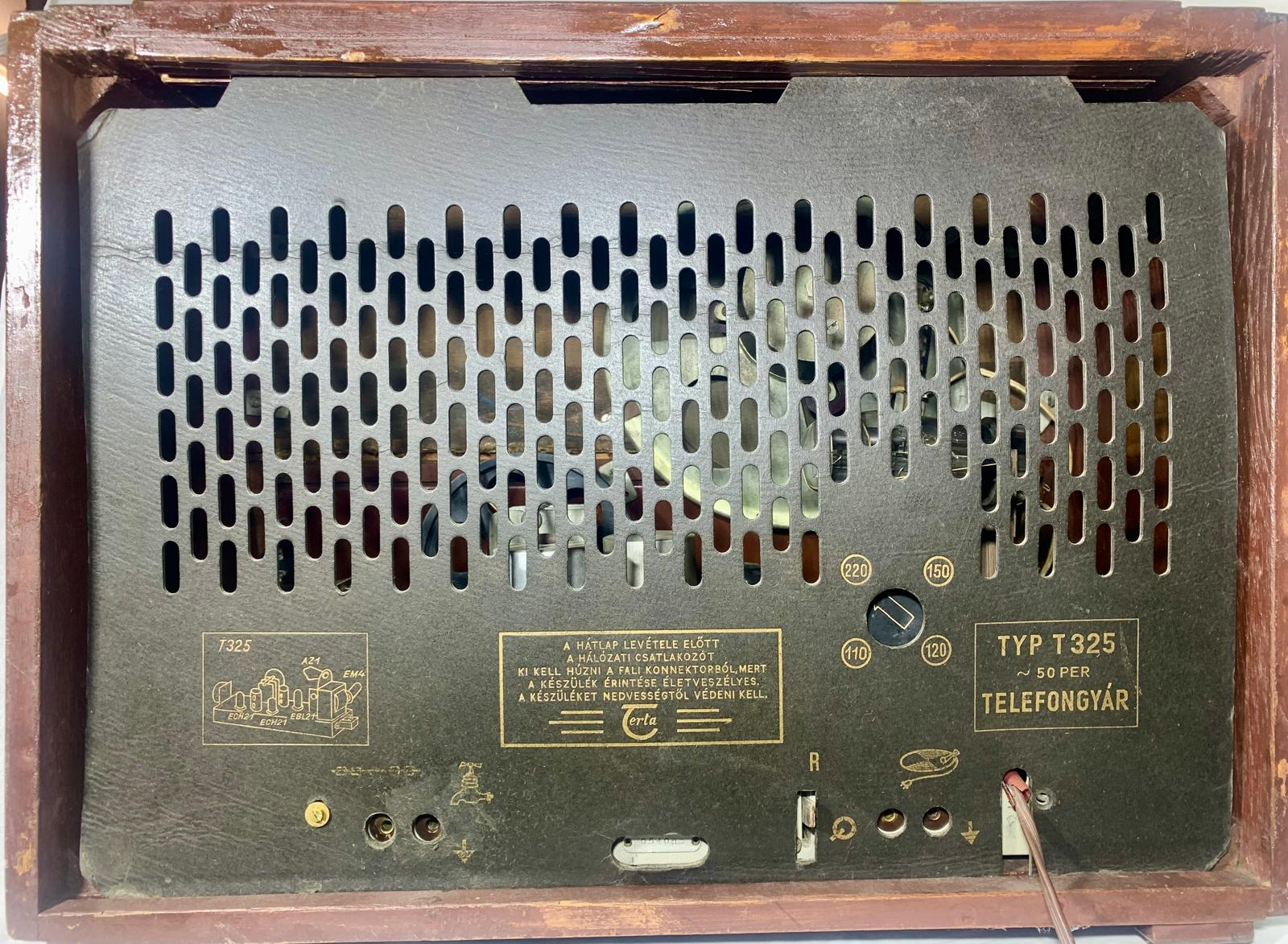
A detail on this particular example is the Hungarian safety notice on the rear panel. Translated, it reads approximately:
Before removing the back cover, the mains plug must be disconnected from the wall socket, because touching the set is life-threatening. The set must be protected from moisture.
The rear panel also carries the Telefongyár marking and the type designation T325, together with the AC mains frequency marking “50 per”, meaning 50 periods per second, or 50 Hz.
Restoration Notes
This Terta T325 was restored with the aim of preserving its original appearance while making it presentable and electrically more reliable.
The cabinet and chassis were cleaned carefully inside and outside. The old finish of the wooden cabinet was no longer satisfactory, so the outside was refinished with a new lacquer coating. This gives the radio a much cleaner appearance while still keeping the character of a 1950s wooden receiver.
As with many valve radios of this age, the paper and electrolytic capacitors required attention. In order to preserve the historic look of the chassis, the original capacitor bodies were opened, modern components were installed inside, and the cases were carefully sealed again. This method keeps the underside of the chassis visually close to its original state while replacing electrically unreliable parts with modern equivalents.
The speaker cloth was also replaced. The new cloth greatly improves the front appearance of the set and gives the radio a much fresher look without changing the overall style.
A Hungarian Radio with Character
The Terta T325 is an interesting example of Hungarian post-war radio production. It is technically conventional, but solidly built, with a large loudspeaker, magic eye tuning indicator and the classic LW/MW/SW waveband coverage of the period.
Today, it also tells a small part of Central European industrial history: a radio made not by one of the well-known German or Austrian brands, but by Telefongyár, a company whose roots were in telephone, railway and communications technology. Restored and cleaned, the T325 once again shows the quiet charm of a mid-1950s wooden valve receiver.
Technical Data
| Item | Data |
|---|---|
| Manufacturer | Telefongyár / Terta |
| Model | Type T325 |
| Country | Hungary |
| Approx. year | 1955–1957 |
| Principle | Superheterodyne receiver |
| Wavebands | Long Wave, Medium Wave, Short Wave |
| Valves | 2 × ECH21, EBL21, AZ1, EM4 |
| IF | approx. 473.6 kHz |
| Power supply | AC mains, multi-voltage versions listed |
| Loudspeaker | Permanent-magnet dynamic loudspeaker, approx. 20 cm |
| Cabinet | Wooden table cabinet |
Circuit Diagram
References and Further Reading
- Radiomuseum.org – Terta / Telefongyár T-325 technical data
- Rádiómúzeum Foundation, Kismaros – Terta T325(H)
- Rádiómúzeum Foundation – Telefongyár / Terta manufacturer history
- NJSZT Informatikatörténeti Fórum – Telefongyár company history
- Berti Benis's – Terta T325
Historical Audio Document – Szabad Európa Rádió, 1956
As a contemporary audio document, this page includes a Hungarian-language Radio Free Europe news broadcast from 12 November 1956. The opening announcement identifies the station as “the voice of free Hungary” on the 25, 31, 41 and 49 metre short-wave bands.
The news reports on the situation in Hungary after the suppression of the 1956 uprising, including Nagy Imre’s refuge in the Yugoslav embassy, United Nations efforts, international reactions, humanitarian aid from Austria, refugees, and demonstrations abroad. Heard today, it gives a powerful impression of the kind of historic short-wave broadcasts that could have been received on a radio such as the Terta T325.
Pictures