VHF and UHF Radio Monitoring & Signal Decoding
See also: LF and HF Radio Monitoring →
This page documents radio signals, reception experiments and decoding techniques in the VHF and UHF spectrum.
The focus is on the signals themselves: what can be received, how the transmission works, which software can be used, and what makes the signal technically interesting.
Some signals on this page are monitored manually or only during occasional experiments. Others are also received continuously by dedicated autonomous OE6VAG receiving systems.
The distinction is important:
- This page describes signals, modes and reception techniques.
- Radio Monitoring – Autonomous Receiving Stations describes the permanent OE6VAG receiving infrastructure.
- Live Data shows the current reception results.
The examples below are ordered approximately by frequency.
For lower-frequency signals, see:
👉 LF and HF Radio Monitoring & Signal Decoding
VHF Airband Voice
VHF airband voice is one of the most accessible monitoring targets above 100 MHz.
Aircraft and ground stations use amplitude modulation, making the signals easy to recognise and receive with almost any SDR.
Typical transmissions include:
- tower
- approach
- departure
- area control
- ATIS
- VOLMET
- aircraft-to-aircraft communication
Aircraft at cruising altitude can often be heard over considerable distances because VHF propagation is primarily line-of-sight and the transmitting aircraft may be more than 10 km above the ground.
Signal Characteristics
| Parameter | Value |
|---|---|
| Frequency range | 118.000–136.975 MHz |
| Mode | AM voice |
| Channel spacing | 25 kHz and 8.33 kHz |
| Typical receive bandwidth | approximately 8–10 kHz |
| Service | Aeronautical voice communication |
| Typical antenna | Vertical VHF antenna, discone, ground plane or dedicated airband antenna |
Receiving
Almost any SDR with suitable VHF coverage can receive airband AM.
Useful software includes:
- SDR++
- SDR#
- GQRX
- CubicSDR
- OpenWebRX
For continuous monitoring of several channels, software such as rtl_airband can be used.
No dedicated OE6VAG autonomous airband voice receiver is currently operated as part of the permanent monitoring station.
VHF ACARS
ACARS is an aircraft data-link system used for short operational messages between aircraft and ground stations.
It predates VDL Mode 2 and uses a comparatively simple 2400 bit/s VHF data channel.
ACARS remains useful as an introduction to digital aviation reception because the signal is easy to recognise and can be decoded with inexpensive SDR hardware.
Signal Characteristics
| Parameter | Value |
|---|---|
| Service | Aircraft Communications Addressing and Reporting System |
| Typical European frequency | 131.725 MHz |
| Other channels | Region-dependent |
| Data rate | 2400 bit/s |
| Radio channel | AM-based VHF data transmission |
| Channel width | 25 kHz |
| Content | Aircraft operational and data-link messages |
Receiving and Decoding
Suitable software includes:
acarsdec- ACARS-capable SDR applications
- SDR++ / SDR# / GQRX for signal observation and recording
Only non-sensitive technical aspects of received traffic are relevant for this project.
OE6VAG Reception Status
An automated VHF ACARS / RAVEN receiving setup has been tested successfully, but it is currently inactive and is therefore not treated as a permanent autonomous receiving station.
👉 See Experimental and Inactive Receivers
VDL Mode 2
VDL Mode 2 is the higher-speed digital successor to classic VHF ACARS and is widely used for modern aircraft data communications.
The transmissions appear as short digital bursts in the upper part of the VHF aeronautical band.
Signal Characteristics
| Parameter | Value |
|---|---|
| Service | VHF Digital Link Mode 2 |
| Frequency range | Upper VHF aviation band |
| Common signalling channel | 136.975 MHz |
| Other European channels | Several additional 25 kHz channels below 136.975 MHz |
| Modulation | D8PSK |
| Symbol rate | 10.5 kBd |
| Raw data rate | 31.5 kbit/s |
| Channel width | 25 kHz |
| Transmission type | Short packet bursts |
VDL2 can transport ACARS traffic as well as higher-layer aeronautical data services.
Receiving and Decoding
Common decoder software includes:
dumpvdl2vdlm2dec- SDR++ with suitable decoder integration
- SDR# / GQRX for spectrum observation and recording
An SDR waterfall clearly shows the characteristic short VDL2 bursts.
VDL2 is currently documented as a reception and decoding target rather than as a permanently published OE6VAG live service.
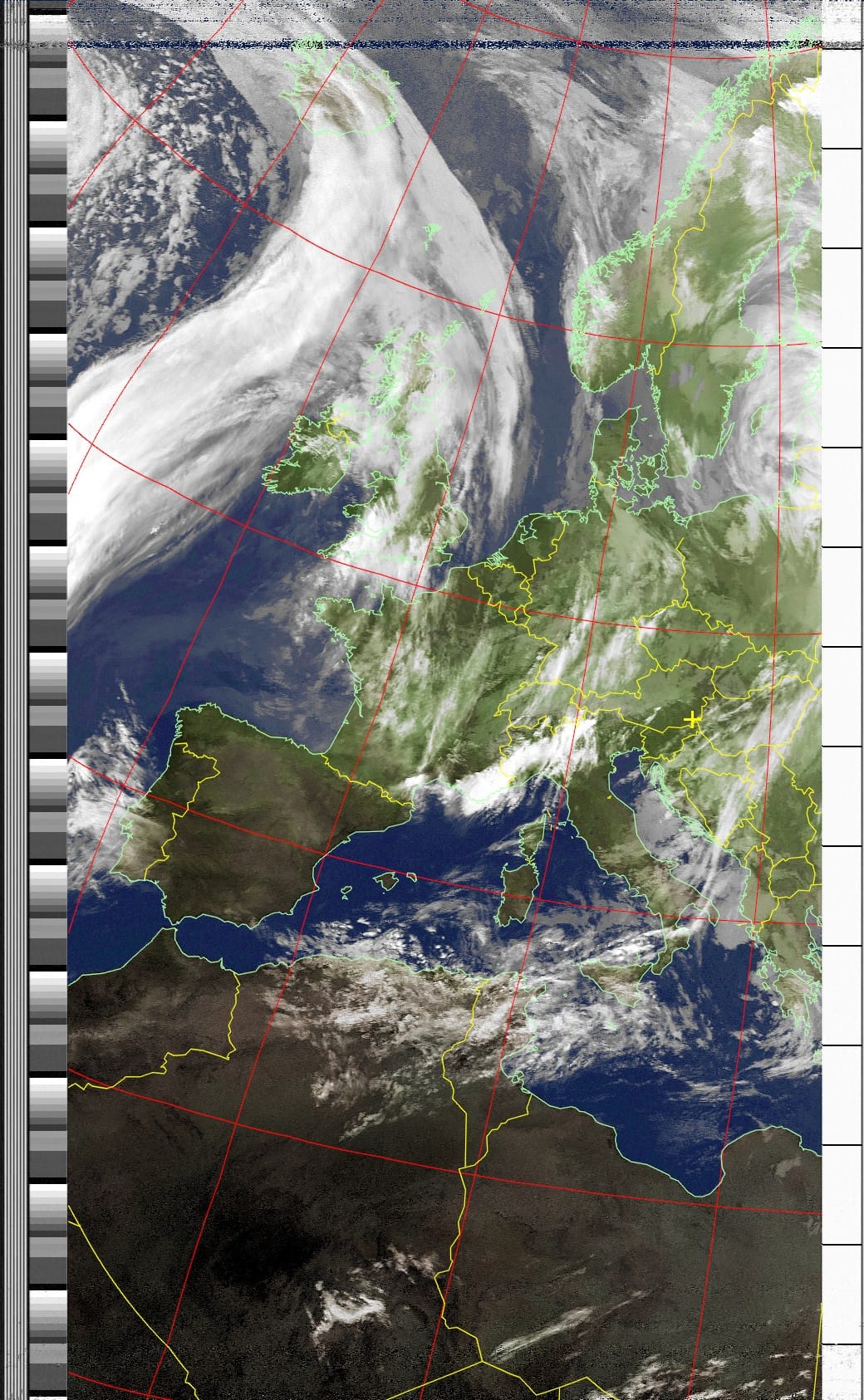
NOAA APT Weather Satellites – Historic Reception
For many years, NOAA polar-orbiting weather satellites were among the most popular signals in the 137 MHz band.
Their analogue APT – Automatic Picture Transmission system produced real-time low-resolution weather images that could be received with very simple equipment.
NOAA-15, NOAA-18 and NOAA-19 have now been decommissioned, making this a historic reception example rather than a current receiving target.
Signal Characteristics
| Parameter | Value |
|---|---|
| Former band | 137 MHz weather-satellite band |
| Mode | Analogue FM APT |
| Image type | Low-resolution weather imagery |
| Typical bandwidth | approximately 40 kHz |
| Polarisation | Circular preferred; simple V-dipoles also worked well |
Receiving and Decoding
Typical software included:
- SatDump
noaa-apt- WXtoImg in older installations
The classic workflow was:
Satellite pass
   ↓
137 MHz RF
   ↓
SDR recording
   ↓
APT demodulation
   ↓
image reconstruction
Although the transmissions are no longer active, archived APT reception remains a useful example of how accessible weather-satellite reception once was.
👉 Open the NOAA APT Reception Archive 2022–2024
OE6VAG Reception Example
METEOR-M LRPT Weather Satellites
The METEOR-M series is the digital continuation of practical 137 MHz weather-satellite reception.
Instead of an analogue APT image, METEOR transmits a digital Low Rate Picture Transmission – LRPT signal.
When reception is good, LRPT can provide significantly better imagery than the former NOAA APT system.
Signal Characteristics
| Parameter | Value |
|---|---|
| Band | 137 MHz weather-satellite band |
| Example OE6VAG target | METEOR-M2-4 |
| Current OE6VAG frequency | approximately 137.9 MHz |
| Signal | LRPT |
| Modulation | QPSK / OQPSK depending on satellite configuration |
| Typical occupied bandwidth | approximately 100–150 kHz |
| Suitable antennas | V-dipole, turnstile, QFH or crossed dipole |
| Typical decoder | SatDump |
Because the satellite is in low Earth orbit, the signal is only available during a pass.
Doppler shift, antenna radiation pattern, pass elevation and local interference all influence reception quality.
Receiving and Decoding
SatDump can perform the complete processing chain:
RF recording
   ↓
carrier / symbol recovery
   ↓
LRPT demodulation
   ↓
packet processing
   ↓
instrument data
   ↓
weather image
Different channel combinations can be produced from the received instrument data.
OE6VAG Reception Example

METEOR LRPT Reception with MeteorGIS
These images belong to an earlier generation of the OE6VAG weather-satellite project. They were received and processed between 2020 and 2022 using the MeteorGIS processing workflow. They are independent of the current SatDump-based autonomous METEOR-M2-4 station.
👉 Open METEOR LRPT Reception with MeteorGIS
OE6VAG Autonomous Reception
METEOR-M2-4 passes are automatically predicted and recorded by the OE6VAG satellite receiving station.
A dedicated QFH antenna and RTL-SDR feed SatDump. After a successful pass, selected image products and reception metadata are transferred automatically to the website.
👉 METEOR-M2-4 on the Live Data page
👉 Autonomous Radio Monitoring Stations
ORBCOMM Satellites
ORBCOMM operates low-Earth-orbit satellite communications in the VHF region.
Its downlinks are located close to the 137 MHz weather-satellite band, so the signals are often encountered while monitoring METEOR or other satellites.
For this project, ORBCOMM is mainly interesting as an example of satellite signal identification rather than message decoding.
Signal Characteristics
| Parameter | Value |
|---|---|
| Frequency region | approximately 137–138 MHz |
| Service | LEO satellite messaging / machine-to-machine communication |
| Signal type | Digital satellite transmissions |
| Propagation effect | Clearly visible Doppler shift |
| Reception purpose | Spectrum observation and signal identification |
The motion of the satellite causes the received frequency to move across the waterfall during the pass.
This makes ORBCOMM a convenient signal for observing Doppler behaviour with a simple SDR.
Receiving
Suitable tools include:
- SDR++
- SDR#
- GQRX
- GNU Radio-based analysis tools
- SatNOGS-style waterfall monitoring
For this website, observation is limited to the technical radio signal rather than private communications content.
GRAVES Meteor Scatter
GRAVES is a French space-surveillance radar transmitting around 143.050 MHz.
The transmitter does not need to be received directly.
Instead, ionised trails created when meteors enter the atmosphere can briefly reflect the radar signal toward the receiving station.
This phenomenon is known as meteor scatter.
Signal Characteristics
| Parameter | Value |
|---|---|
| Frequency | approximately 143.050 MHz |
| Source | GRAVES radar |
| Reception type | Forward-scatter reflection |
| Observed signal | Narrow radar carrier |
| Events | Short pings, bursts or longer meteor trails |
| Useful antenna | Directional VHF antenna |
On a waterfall display, a meteor may produce a very short trace or a longer reflection whose frequency changes as the ionised trail evolves.
During major meteor showers, the number of reflections can increase noticeably.
Receiving and Analysis
Useful software includes:
- Spectrum Lab
- SDR++ / SDR#
- FFT logging software
- meteor-scatter logging tools
A narrow waterfall span around the radar frequency makes small Doppler shifts and individual reflections easier to see.
APRS
APRS — the Automatic Packet Reporting System — is widely used in amateur radio for transmitting position, telemetry and short status information.
In Europe, the main terrestrial APRS channel is 144.800 MHz.
Signal Characteristics
| Parameter | Value |
|---|---|
| Service | Amateur radio packet system |
| European VHF frequency | 144.800 MHz |
| Typical mode | 1200 baud AX.25 packet |
| Audio modem | Bell 202 AFSK |
| Content | Position, telemetry, weather and short status data |
| Typical channel width | Narrowband FM |
A received packet can contain a station callsign, geographic position and additional telemetry or status data.
Receiving and Decoding
Common software includes:
- Dire Wolf
- SoundModem
- APRSIS32
- SDR receiver software for FM demodulation
APRS packets can also be forwarded through the APRS-IS Internet infrastructure.
OE6VAG Integration
The current OE6VAG APRS integration uses a WX3IN1 Plus 2.0.
The controller supports RF APRS, but the normal current configuration primarily uses the network connection and APRS-IS rather than acting as another permanent SDR receive chain.
👉 Autonomous Radio Monitoring Stations
ISS SSTV and Amateur Radio Satellites
The International Space Station and amateur-radio satellites provide a large variety of VHF and UHF signals.
Depending on the satellite or event, these can include:
- FM voice
- packet / APRS
- telemetry
- CW beacons
- linear transponders
- SSTV images
The satellites move quickly relative to the receiving station, so Doppler correction is an important part of satellite reception, especially on UHF.
Typical ISS Signals
| Service | Typical frequency |
|---|---|
| ISS SSTV during scheduled events | 145.800 MHz FM |
| ISS APRS / packet | 145.825 MHz |
| ISS cross-band repeater | VHF uplink / UHF downlink |
| Other amateur satellites | Various VHF/UHF allocations |
SSTV activity is event-based and should not be expected continuously.
Receiving and Decoding
Useful software includes:
- MMSSTV
- QSSTV
- RX-SSTV
- Dire Wolf for APRS / AX.25
- Gpredict
- Look4Sat
- SatDump
- SDR++ / SDR# / GQRX
A handheld Yagi can be sufficient for many strong satellite passes. More sophisticated stations use crossed Yagis or computer-controlled azimuth/elevation tracking.
AIS – Marine Automatic Identification System
AIS is the VHF tracking system used by ships.
Vessels broadcast identification, position, course, speed and other navigational information on two main VHF channels.
Signal Characteristics
| Parameter | Value |
|---|---|
| AIS 1 | 161.975 MHz |
| AIS 2 | 162.025 MHz |
| Modulation | GMSK |
| Data rate | 9600 bit/s |
| Channel width | 25 kHz |
| Content | Vessel identification and navigation data |
| Typical antenna | Vertical marine-band VHF antenna |
Reception range depends heavily on antenna height and terrain.
For an inland receiving location, activity may be limited compared with coastal sites, but AIS remains an interesting example of a structured VHF data service.
Receiving and Decoding
Suitable software includes:
- AIS-catcher
rtl_ais- OpenCPN for map display
- SDR++ / SDR# for spectrum observation
AIS is currently treated as an experimental monitoring target rather than a permanent OE6VAG live service.
DAB+ Digital Radio
DAB+ is a digital broadcasting system rather than a utility-radio signal.
It is nevertheless useful as an SDR test signal because one multiplex occupies more than a megahertz of spectrum and therefore tests receiver bandwidth, USB throughput and frequency stability.
Signal Characteristics
| Parameter | Value |
|---|---|
| Band | VHF Band III |
| Frequency range | approximately 174–240 MHz |
| Channel blocks | 5A–13F |
| Occupied bandwidth | approximately 1.536 MHz |
| Modulation | COFDM |
| Content | Multiple digital audio services and associated data |
Unlike narrowband VHF signals, the complete DAB multiplex appears as a broad rectangular block in the SDR waterfall.
Receiving and Decoding
Useful software includes:
- welle.io
- QIRX
- DABlin
- SDR++ / SDR# for spectrum observation
DAB+ is a particularly convenient way to test whether an SDR installation can process wider real-time bandwidths reliably.
Radiosonde Telemetry
Meteorological radiosondes are carried by weather balloons and transmit measurements while ascending through the atmosphere.
Typical telemetry includes:
- position
- altitude
- temperature
- relative humidity
- pressure or derived pressure information
- ascent rate
Modern Vaisala RS41 sondes operate in the 400–406 MHz meteorological band.
Signal Characteristics
| Parameter | Value |
|---|---|
| Typical band | 400–406 MHz |
| Example sonde | Vaisala RS41 |
| RS41 modulation | GFSK |
| RS41 data rate | 4800 bit/s |
| Content | Meteorological measurements and GNSS position |
| Propagation | Line-of-sight from a high-altitude balloon |
Because a balloon can reach altitudes of 30 km or more, radiosondes can be received over surprisingly large distances despite their low transmitter power.
Receiving and Decoding
Suitable software and receivers include:
- radiosonde_auto_rx
- SondeMonitor
- rdzTTGOsonde
- compatible SDR receivers and decoders
OE6VAG Autonomous Reception
OE6VAG uses an rdzTTGOsonde receiver with a simple quarter-wave antenna.
Decoded telemetry is forwarded to public radiosonde networks and simultaneously recorded by the local OE6VAG infrastructure.
Only flights actually received by the local station are shown on the OE6VAG map.
👉 Radiosondes on the Live Data page
👉 Open the OE6VAG Radiosonde Map
👉 Autonomous Radio Monitoring Stations
TinyGS and LoRa Satellite Telemetry
TinyGS is an open network of small satellite ground stations based primarily on inexpensive ESP32 and LoRa hardware.
Unlike general-purpose SDR satellite reception, the radio hardware, demodulation and network forwarding are integrated into a compact embedded receiver.
Satellite missions supported by TinyGS can use different LoRa configurations, frequencies and data rates.
Signal Characteristics
| Parameter | Value |
|---|---|
| OE6VAG band | approximately 868 MHz |
| Signal family | LoRa / compatible satellite telemetry |
| Platform | ESP32 / LILYGO / TTGO |
| Reception | Satellite packets during suitable passes |
| Data handling | Automatic forwarding to the TinyGS network |
The LoRa waveform is especially interesting because it uses chirp spread spectrum and can decode signals well below the apparent noise level.
OE6VAG Autonomous Reception
A dedicated TinyGS receiver is installed in the attic and operates continuously.
Successfully received packets are forwarded automatically to the TinyGS network.
👉 TinyGS on the Live Data page
👉 Open the OE6VAG TinyGS Station
👉 Autonomous Radio Monitoring Stations
ADS-B and Mode S Aircraft Signals
ADS-B is one of the best-known examples of digital UHF reception.
Aircraft periodically broadcast identification, position, altitude, velocity and other information on 1090 MHz using Mode S Extended Squitter.
Unlike HFDL, which can cover intercontinental distances through HF propagation, ADS-B is essentially a local line-of-sight system.
Signal Characteristics
| Parameter | Value |
|---|---|
| Frequency | 1090 MHz |
| Signal family | Mode S / ADS-B Extended Squitter |
| Modulation | Pulse-position modulation |
| Bit rate | 1 Mbit/s |
| ADS-B message length | 112 bits |
| Content | Aircraft identity, position, altitude, velocity and status |
| Propagation | Primarily line-of-sight |
Aircraft at high altitude can be received over distances of several hundred kilometres when antenna placement and terrain are favourable.
Receiving and Decoding
ADS-B is particularly easy to receive with RTL-SDR hardware because a large software ecosystem already exists.
Common tools include:
readsbdump1090tar1090- Virtual Radar Server
- various ADS-B feeder packages
A dedicated 1090 MHz antenna and low-noise amplifier can significantly improve reception range.
OE6VAG Autonomous Reception
The OE6VAG ADS-B station operates continuously using a dedicated RTL-SDR and an outdoor DIY 1090 MHz cantenna.
readsb performs the decoding and tar1090 provides the local aircraft map.
The data displayed by OE6VAG originate from aircraft actually received by the local ground station.
👉 Open the OE6VAG ADS-B Live Map
👉 Autonomous Radio Monitoring Stations
Inmarsat-C / SafetyNET / EGC
The Inmarsat system operates in L-band and therefore lies within the upper part of the UHF spectrum.
Inmarsat-C is a low-data-rate satellite communication system used extensively in the maritime sector.
One particularly interesting receive-only service is Enhanced Group Call – EGC, which can carry SafetyNET maritime safety information.
Depending on the received traffic, messages may include:
- navigational warnings
- meteorological warnings
- safety information
- urgency or distress-related broadcasts
- routine group messages
Signal Characteristics
| Parameter | Value |
|---|---|
| Band | L-band |
| OE6VAG downlink | approximately 1.537 GHz |
| System | Inmarsat STD-C |
| Data type | EGC / SafetyNET-related messages |
| Reception | Geostationary satellite |
| Typical decoder | SatDump |
Unlike low-Earth-orbit satellites, the Inmarsat satellite remains at essentially the same point in the sky.
This allows the use of a fixed directional or patch antenna.
Receiving and Decoding
An L-band capable SDR and suitable filtered / amplified antenna are normally required.
SatDump can demodulate and decode supported Inmarsat-C channels and extract EGC messages.
OE6VAG Autonomous Reception
The OE6VAG L-band receiver uses a dedicated SDR and active patch antenna.
The selected Inmarsat STD-C channel is received continuously and processed by SatDump.
Decoded EGC messages are filtered and transferred automatically to the website.
The displayed information is experimental reception only and must not be used for navigation or safety-critical purposes.
👉 Inmarsat-C on the Live Data page
👉 Open All Received Inmarsat-C Messages
👉 Autonomous Radio Monitoring Stations
Manual Reception and Autonomous Monitoring
The signals on this page represent different types of reception.
Some are mainly investigated interactively:
antenna
   ↓
SDR
   ↓
receiver software
   ↓
decoder / spectrum analysis
   ↓
operator
Examples include:
- airband voice
- VDL Mode 2
- ORBCOMM
- GRAVES meteor scatter
- AIS
- DAB+
- amateur-radio satellite experiments
Other services use dedicated autonomous receivers:
antenna
   ↓
dedicated receiver
   ↓
decoder
   ↓
local processing
   ↓
web publication
Current examples include:
- METEOR-M2-4
- ADS-B
- radiosondes
- TinyGS
- Inmarsat-C
APRS is integrated differently because its current web path primarily uses APRS-IS rather than acting as another local SDR receive chain.
This separation allows this page to remain focused on radio signals and decoding, while the permanent infrastructure is documented centrally on the autonomous-stations page.
Equipment for VHF and UHF Monitoring
Many of the signals on this page can be received with relatively inexpensive SDR hardware.
In practice, the antenna and its location often have a greater effect on reception than changing from one modern SDR to another.
Typical SDR Receivers
Suitable receivers include:
- RTL-SDR Blog V3 / V4
- Nooelec NESDR series
- Airspy Mini / Airspy R2
- SDRplay RSP receivers
- HackRF for experimental wider-band applications
Different services may benefit from dedicated hardware. For example, ADS-B reception does not need a wide-coverage HF-capable SDR.
Typical Antennas
Examples include:
| Application | Typical antenna |
|---|---|
| VHF airband | Vertical / discone / ground plane |
| 137 MHz satellites | V-dipole / QFH / turnstile |
| GRAVES | Directional VHF Yagi |
| APRS | 2 m vertical |
| AIS | Marine-band vertical |
| Amateur satellites | Handheld or crossed Yagi |
| Radiosondes | Quarter-wave or vertical UHF antenna |
| TinyGS | Suitable 868 MHz antenna |
| ADS-B | Dedicated 1090 MHz antenna |
| Inmarsat | Active L-band patch or directional antenna |
Useful Accessories
Depending on the application, useful additions include:
- low-noise amplifier
- band-pass filter
- FM broadcast notch filter
- good low-loss coaxial cable
- stable oscillator
- bias-tee powered antenna amplifier
- outdoor antenna placement
For weak satellite signals, filtering before amplification can be particularly important in RF-dense environments.
Signals Above UHF
This page intentionally ends with L-band reception.
Some OE6VAG projects use still higher frequencies, but technically these are no longer VHF/UHF.
For example, the mobile C-ITS / ITS-G5 project operates around the 5.9 GHz region and therefore belongs to the SHF spectrum.
It is nevertheless part of the overall radio-monitoring project.
👉 Open the C-ITS Drive Archive
👉 Autonomous Radio Monitoring Stations
Related OE6VAG Pages
👉 Autonomous Radio Monitoring Stations
👉 LF and HF Radio Monitoring & Signal Decoding
👉 Open the OE6VAG ADS-B Live Map
👉 Open the OE6VAG Radiosonde Map
👉 Open All Received Inmarsat-C Messages
👉 Open the OE6VAG TinyGS Station
About These Reception Examples
The signals and systems documented on this page are part of a private, non-commercial radio and signal-processing project.
The purpose is to document practical radio reception, signal characteristics and decoding techniques — not to provide a complete frequency database.
Where an autonomous OE6VAG receiver is linked, the displayed data originate from signals received or processed by the local station.
Other sections document signals that have been investigated experimentally or that are useful potential monitoring targets.
Frequencies, satellite configurations and active services can change over time. For operational or safety-critical information, always refer to the responsible official service.