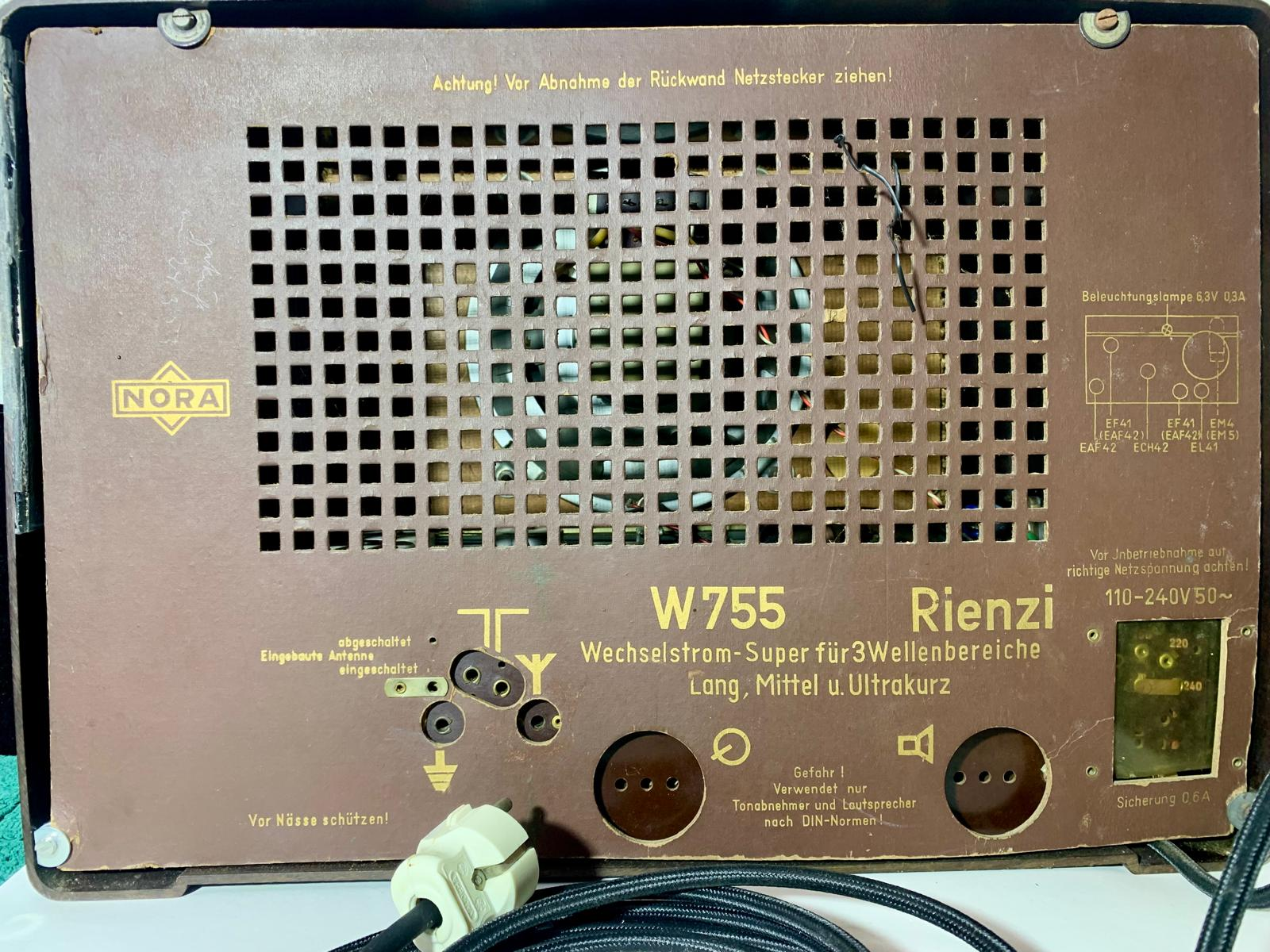
Nora Rienzi W755 – Early Post-War FM Radio from Berlin
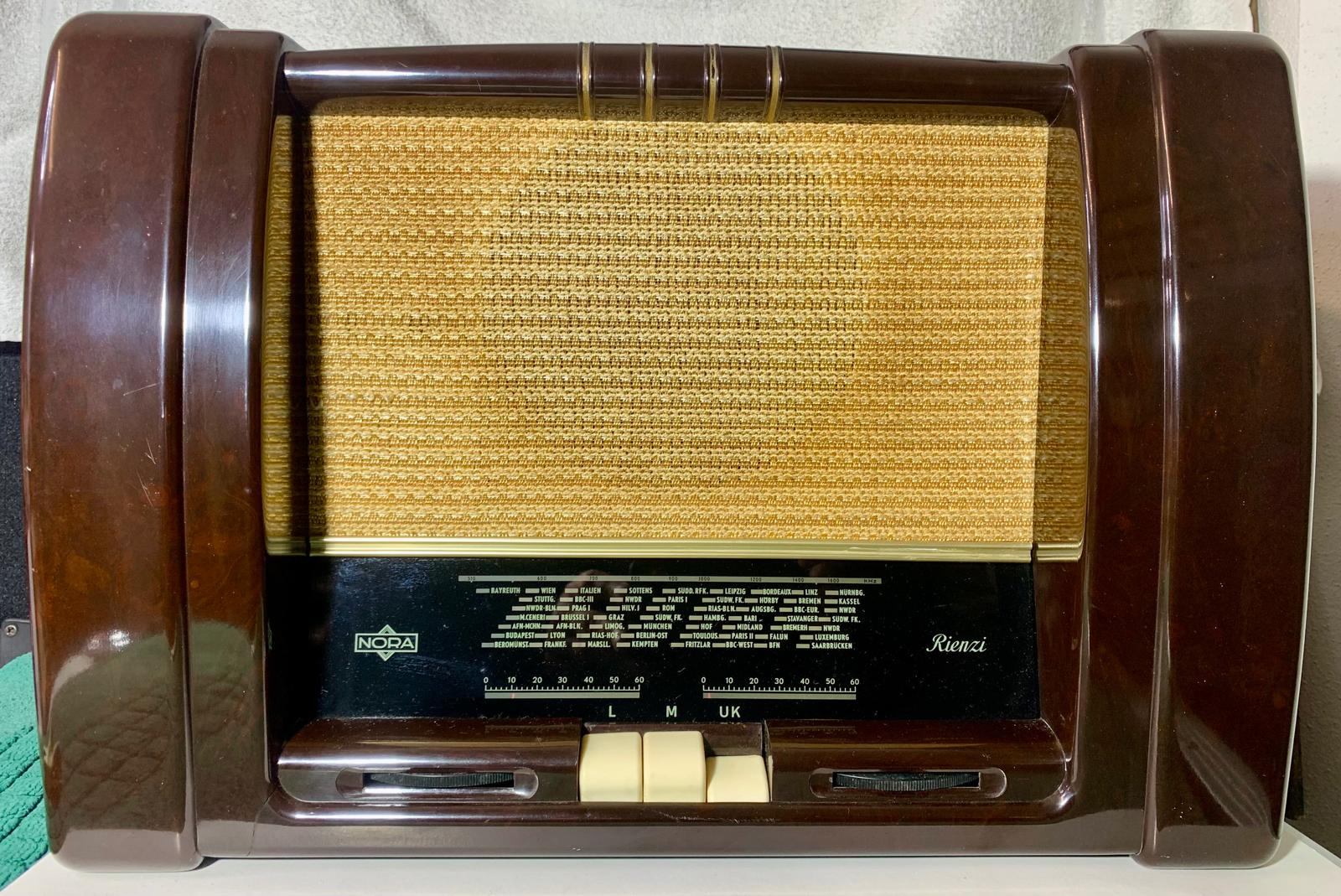
The Nora Rienzi W755 is a German table radio from the early 1950s and represents an interesting moment in radio history: the transition from traditional AM broadcasting to the new FM era.
This particular set is the Bakelite cabinet version of the W755, built around 1951/1952 by Nora / Aron / Heliowatt in Berlin. It combines Long Wave, Medium Wave and FM reception in a compact but surprisingly heavy cabinet. With its rounded Bakelite body, simple dial layout and early FM circuitry, the Rienzi W755 still carries much of the pre-war radio design tradition, while already pointing toward the modern VHF/FM receivers of the 1950s.
Technical Overview
- Model: Nora Rienzi W755, without magic eye tuning indicator
- Manufacturer: Nora, Aron, Heliowatt; Berlin
- Year: 1951/1952
- Country: Germany
- Cabinet: Bakelite
- Wavebands: Long Wave, Medium Wave, FM
- Principle: Superheterodyne receiver
- Intermediate frequencies: 473 kHz / 10.7 MHz
- Tubes: ECH42, EAF42, EAF42, EL41, AZ41
- Loudspeaker: Permanent magnet dynamic speaker, approx. 16 cm
- Power supply: AC mains, 110–240 V
- Dimensions: approx. 475 × 310 × 200 mm
- Weight: approx. 10 kg
- Original price: 253 DM
The technical data identify the W755 as a typical early-1950s German superheterodyne receiver, but with an important addition: FM reception. At the beginning of the 1950s, FM was still a relatively new feature in domestic receivers, especially in sets that still visually and mechanically followed the late-1940s radio tradition. The W755 therefore belongs to the early generation of post-war radios that helped establish FM listening in German households.
Nora, Aron and Heliowatt – A Company with a Complex History
The name Nora is more than just a radio brand. It is closely connected with the history of the Aron company in Berlin.
The origins go back to Hermann Aron, a physicist and entrepreneur who founded an experimental workshop in Berlin in 1883. Aron became known for his work on electricity meters, especially the electromechanical watt-hour meter, and his company grew into an important manufacturer of electrical measuring equipment. Over time, the business expanded internationally, with branches and production sites in several European countries.
In the 1920s, under Manfred Aron, the company entered the radio market. From around 1923, radio receivers were produced under the brand name Nora. The name itself is widely understood as “Aron” written backwards — a short, memorable brand name that became well known in the German radio market.
By the early 1930s, Nora had become one of the significant German radio manufacturers. Contemporary company-history summaries list Nora among the larger German radio producers of the period, with a notable market share before the Second World War.
The company’s history then took a darker turn. After the National Socialists came to power in 1933, the company and the Aron family came under increasing political pressure because of the family’s Jewish background. The company was renamed Heliowatt Werke Elektrizitäts-Aktiengesellschaft. This renaming did not protect Manfred Aron and his family from persecution. Historical accounts describe how Manfred Aron was pressured, arrested, and forced to sell the family’s shares under the conditions of Nazi “Aryanization”. The shares eventually passed through Deutsche Bank and then to Siemens.
After the war, Heliowatt was re-established in West Berlin. Nora radio production resumed, but the company never regained its earlier position in the radio market. In the early 1950s, sets like the Rienzi W755 were part of this post-war attempt to rebuild the Nora brand. However, by the mid-1950s Heliowatt increasingly focused again on meters, timers and measuring equipment, while radio and television production gradually came to an end.
This background gives the Rienzi W755 a significance beyond its technical design. It is not only an early FM radio, but also a product from a company whose story reflects innovation, persecution, forced ownership change, post-war reconstruction and eventual disappearance from the radio market.
Design and Cabinet
The Bakelite cabinet gives the Nora Rienzi W755 a solid and slightly conservative appearance. Compared with many later 1950s radios, which often used polished wooden cabinets, large speaker cloth areas and decorative brass trim, the Rienzi looks more restrained.
The cabinet is wide and rounded, with the speaker grille integrated into the front and the station dial positioned clearly above or beside the controls. The dark Bakelite material gives the radio a robust, almost pre-war character. At around 10 kg, the set is also much heavier than its size might suggest.
The design fits well into the early post-war period: functional, compact and practical, but still with enough visual presence to be placed prominently in a living room.
Early FM Reception
One of the most interesting aspects of the Nora Rienzi W755 is its early FM capability.
In Germany, FM broadcasting expanded strongly after the Second World War. Early FM receivers were often technically different from later, more refined FM radios. The W755 uses an early FM implementation and is listed with 10.7 MHz FM intermediate frequency, which later became the standard for FM receivers.
Unlike later luxury radios, this model does not have a magic eye tuning indicator. Tuning therefore relies entirely on the dial, the sound and the user’s ear. That gives the set a very direct operating feel. It is less “assisted” than later 1950s radios, but this also makes it an interesting example of early domestic FM technology.
Tube Line-Up
The tube complement of the Nora Rienzi W755 is:
- ECH42 – frequency changer / mixer-oscillator
- EAF42 – IF amplifier / detector stage
- EAF42 – additional IF / detector or AF-related stage
- EL41 – audio output tube
- AZ41 – rectifier
This is a compact but capable tube line-up for a post-war table receiver. The EL41 output tube provides enough audio power for normal room listening, while the two EAF42 tubes reflect the receiver’s combined AM/FM signal processing requirements.
Listening Experience
When restored and properly aligned, the Rienzi W755 should deliver the characteristic warm sound of early-1950s German tube radios. The single loudspeaker and Bakelite cabinet do not aim for hi-fi reproduction in the modern sense, but the result is pleasant and historically authentic.
On AM, the set gives the familiar narrow-band vintage radio sound. On FM, the listening experience is more open, although still shaped by the limitations of the early FM circuitry and the cabinet acoustics.
Used today with an AM transmitter or a small Bluetooth-to-AM setup, radios like the Rienzi W755 can be enjoyed without modifying the original circuit. This makes it possible to listen to modern audio sources while keeping the radio electrically and historically close to its original design.
Restoration Notes
This Nora Rienzi W755 was a pleasant restoration project, as the radio was complete and in very good basic condition. In fact, it essentially worked again almost immediately after the first careful checks.
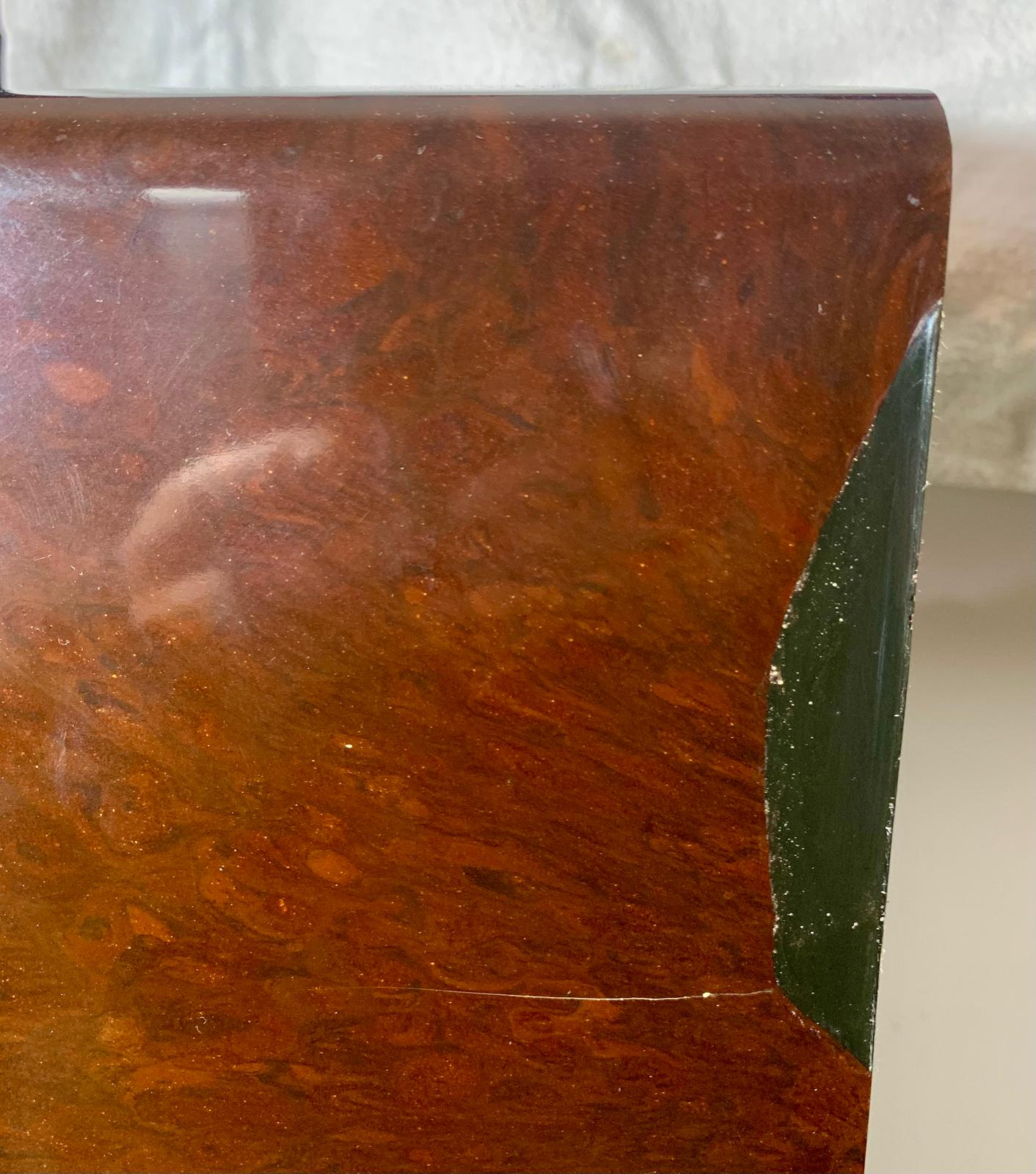
The set was thoroughly cleaned inside and outside. The Bakelite cabinet received special attention: it was gently cleaned and polished to preserve its original surface and restore its characteristic deep shine. One broken corner of the Bakelite cabinet was repaired with epoxy resin; unfortunately, the colour tone could not be matched exactly.
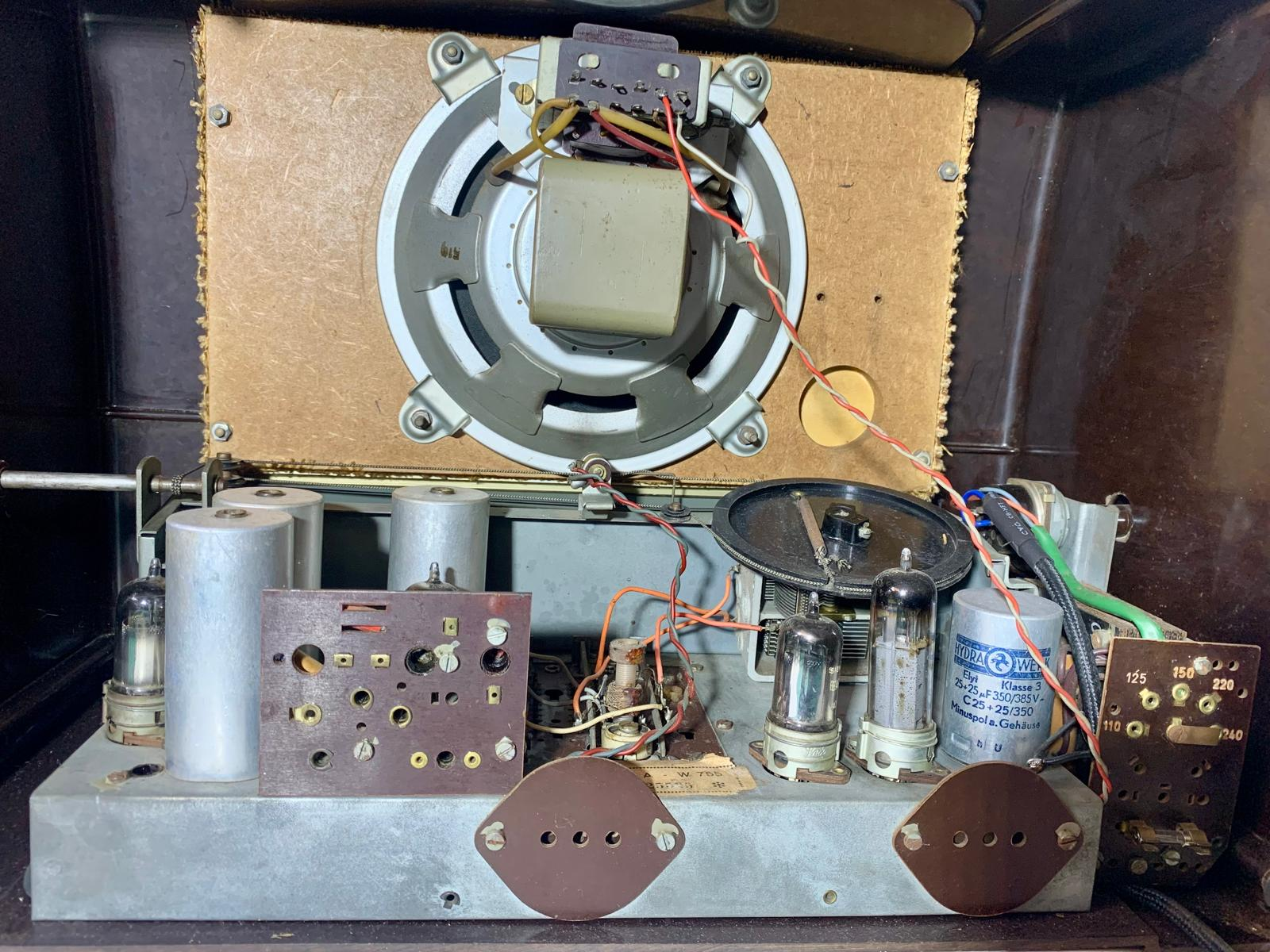
The electrolytic capacitors and paper capacitors were renewed in the same way as on my other restorations. The original capacitor bodies were opened, modern components were installed inside, and the parts were then closed again. This keeps the underside of the chassis visually close to its original factory appearance while making the radio electrically reliable again.
For safety reasons, the old mains cable was replaced. Apart from that, only minor cleaning, inspection and checking work was necessary. Overall, the radio required very little repair and could largely be preserved in its original condition.
Historical Significance
The Nora Rienzi W755 is not a large luxury radio and not one of the famous high-end German “Klangwunder” sets of the later 1950s. Its importance lies elsewhere.
It represents a short and fascinating period: the early post-war reconstruction of a once-important Berlin radio brand, the introduction of FM into ordinary domestic receivers, and the final chapter of Nora as a radio manufacturer.
Behind the Nora name stands the much older Aron company — a story of technical innovation, international success, persecution under the Nazi regime, forced transfer of ownership, and post-war rebuilding. In that sense, the Rienzi W755 is more than a Bakelite radio. It is a small surviving object from a complicated industrial and human history.
Circuit Diagram
References and Further Reading
- Radiomuseum.org – Nora Rienzi W755, Bakelite cabinet version
- Radiomuseum.org – Nora, Aron, Heliowatt; Berlin manufacturer profile
- Antik Radio – Nora company history
- VDE History Map – Heliowatt AG
- Radiogeschichte.de – Nora / Aron, Berlin
Pictures