What Is an Electromagnetic Wave?
The Physics Behind Radio – Chapter 1
A radio receiver is a curious device. It does not collect sound from the air like an ear. It does not listen to pressure waves travelling through the atmosphere. Instead, it responds to invisible changes in electric and magnetic fields. Only after these changes have been received, amplified, filtered and converted does a loudspeaker finally move air and create sound. That distinction is important. Sound is a mechanical disturbance in matter: a pattern of pressure and density moving through air, water or some other material. A radio wave is something else entirely. It is an electromagnetic wave: a travelling arrangement of electric and magnetic fields. Unlike sound, it does not need air, water or any other material carrier; electromagnetic waves can also propagate through vacuum [1]. This idea sounds abstract because we do not directly see electric or magnetic fields. We see their effects. A charged comb attracts small pieces of paper. A compass needle turns near a magnet. A spark jumps across an air gap. A radio antenna produces a voltage when a transmitter far away is switched on. In each case, something in space seems to exert influence without visible contact. For a long time, this was one of the deepest puzzles in physics. How can one object affect another across empty space? Is there some hidden mechanical connection? Is there an invisible medium? Or is space itself carrying something? The story of electromagnetic waves begins with that question.
From forces to fields
A useful starting point is the electric field. An electric field describes what an electric charge does to the space around it. If we place a small positive test charge somewhere in that space, the field tells us what force the charge would feel and in which direction it would move. In modern textbook language, the electric field is force per unit charge [2]. That sounds like a simple definition, but it represents a major change in thinking. Instead of saying only that one charge pulls or pushes another charge at a distance, we say that the first charge creates a condition in space. The second charge then responds to the local field at its own position. A magnetic field is similar in spirit, but different in behaviour. A stationary electric charge feels an electric force. A magnetic force, however, acts on moving charges, electric currents and magnetic dipoles. This is why a compass needle aligns itself in Earth’s magnetic field, and why a current-carrying wire can experience a force near a magnet [2]. Electric and magnetic fields are therefore closely related, but they are not simply the same thing under two names. Electric fields are associated with charge. Magnetic fields are associated with moving charge, current and changing electric fields. The full connection between them is one of the great achievements of nineteenth-century physics.
Faraday’s invisible lines
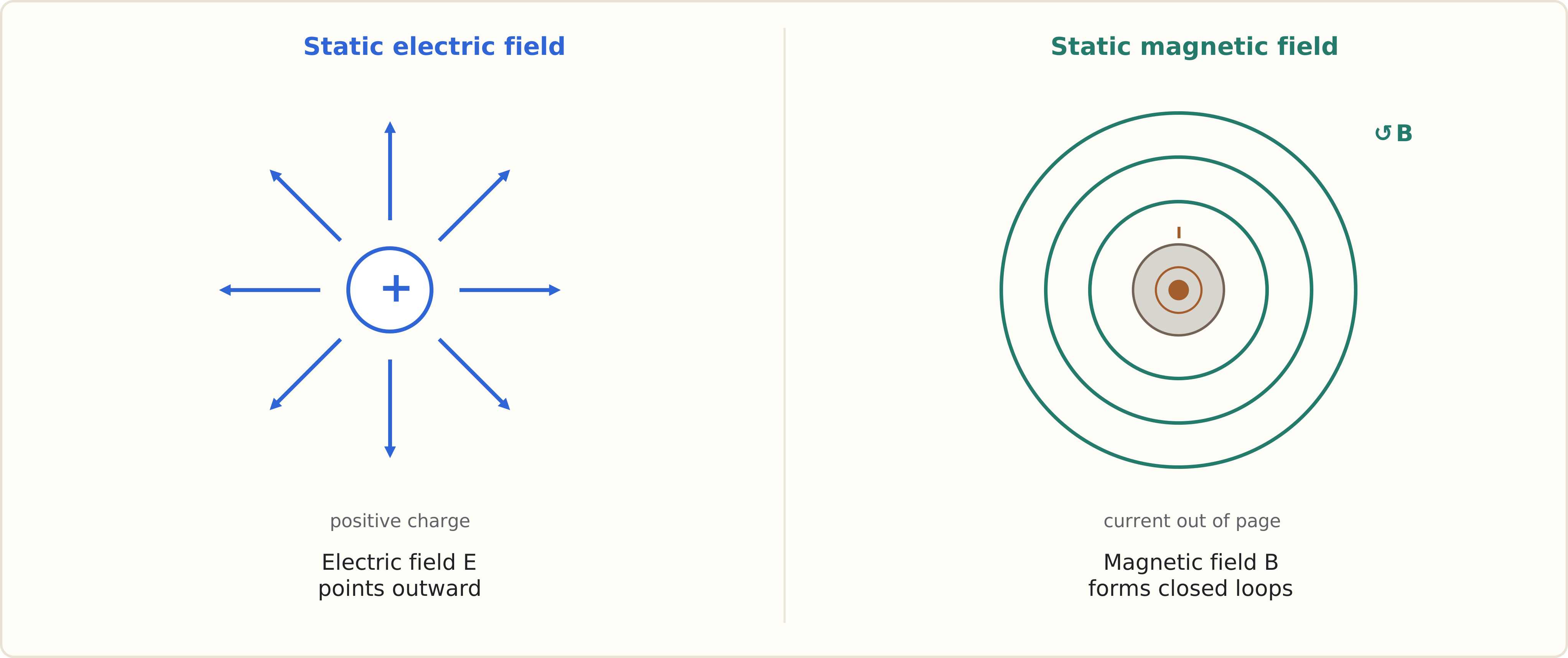
Michael Faraday was one of the central figures in changing the way physicists thought about electricity and magnetism. He was not primarily a mathematical theorist. He was an experimental genius with a powerful physical imagination. When Faraday sprinkled iron filings around a magnet, the filings arranged themselves into graceful curves. Around a bar magnet they formed loops from one pole to the other. Around a current-carrying wire they formed circles. These patterns were not random decorations. They revealed directions in which magnetic effects acted. Faraday called them lines of force. Today we usually treat field lines as visual tools. They are not physical strings in space. A charged particle does not have to travel along a field line, and the line itself is not a material object. A field line simply shows the direction of the field at each point. Where field lines are drawn more densely, the field is stronger [3]. But Faraday’s intuition went deeper than a drawing convention. To him, the space around charges, currents and magnets was not passive emptiness. It had physical structure. The field was not merely a mathematical trick for calculating forces; it was the local state of space through which electrical and magnetic effects were transmitted [4]. That idea is the first conceptual step toward radio. A radio wave is not a small object flying from the transmitter to the receiver. It is a changing field pattern spreading outward through space. Faraday did not yet have the final mathematical theory of such waves, but his field concept made it possible to think about them [4].
Static fields are not yet waves
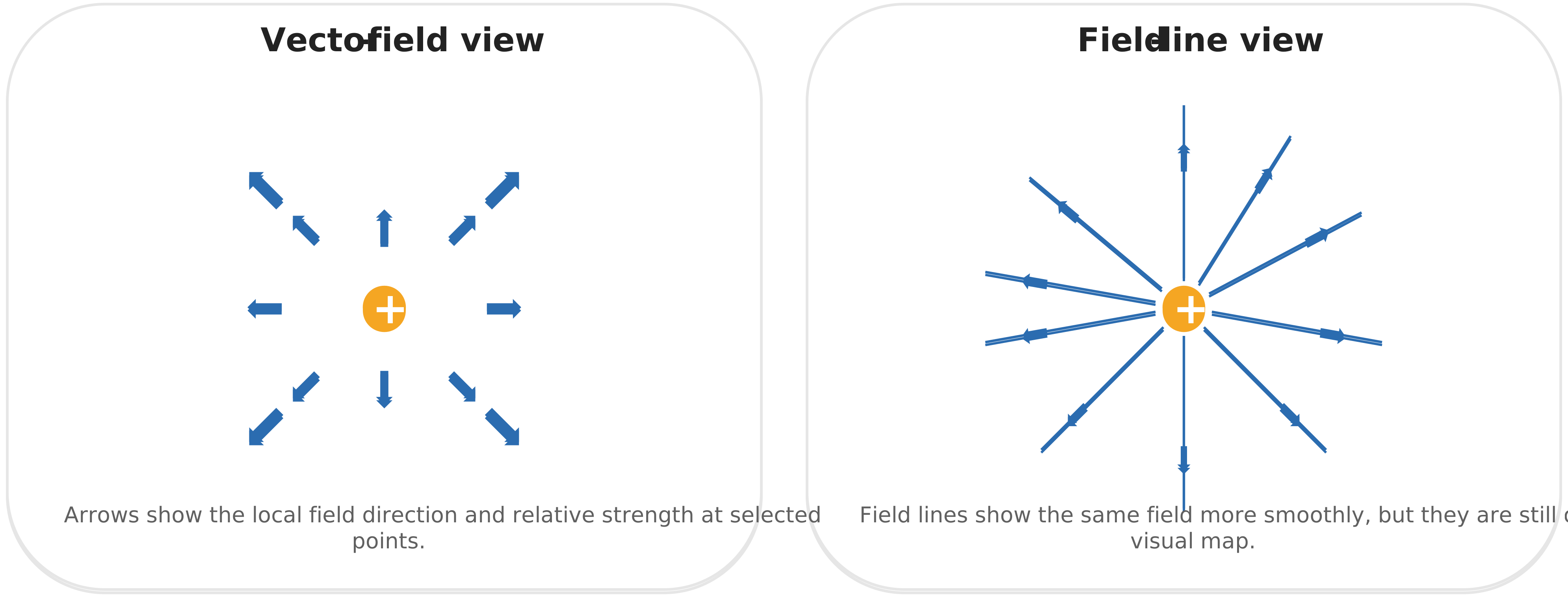
It is tempting to say that wherever there is an electric or magnetic field, there is already something like radio. That is not correct. A charged object at rest produces an electric field. A permanent magnet produces a magnetic field. A steady direct current produces a magnetic field around a wire. These fields may fill the space around the object, but they do not automatically form an electromagnetic wave [5]. A wave requires change. More precisely, an electromagnetic wave involves electric and magnetic fields that vary with time and space in a coupled way. The field pattern does not merely sit around its source. It propagates. It carries energy and momentum away from the source. Far from the transmitter, in the ideal case of a plane wave in free space, the electric field, the magnetic field and the direction of propagation are all perpendicular to one another [5], [6]. That simple picture — electric field one way, magnetic field at right angles, wave travelling in a third direction — is often shown in diagrams. It is a very useful image, but it is also a simplified one. Near antennas, inside cables, close to circuits and around reactive components, the field structure can be much more complicated. Later chapters of this series will return to those regions.
A common source of confusion is the phrase that a changing electric field produces a magnetic field, and a changing magnetic field produces an electric field. In a freely propagating far-field wave, this does not mean that the two fields take turns. The electric and magnetic field components rise, fall and reverse together. They are in phase. What Maxwell’s equations describe is not a local exchange, but a coupled space-and-time structure that carries energy forward.
For now, the key point is this:
A static field is a condition in space.
An electromagnetic wave is a travelling disturbance of fields.
Figure 1.3: Idealized electromagnetic wave. In the far field, an electromagnetic wave can be represented as coupled electric and magnetic fields travelling through space. This idealized drawing is useful, but real antenna fields are more complex near the source. Animation: Walter Fendt, “Elektromagnetische Welle”. Source / rights note: Walter Fendt HTML5 physics animation, locally hosted version, used under Creative Commons BY-NC-SA 3.0 . Original page: Walter Fendt HTML5 animation .
Maxwell closes the loop
James Clerk Maxwell took Faraday’s field intuition and turned it into a mathematical theory. Before Maxwell, physicists already knew several important laws. Electric charges produce electric fields. Electric currents produce magnetic fields. Faraday had shown that a changing magnetic field can induce an electric field; this is the principle behind generators, transformers and inductors [5]. But there was an asymmetry. If a changing magnetic field can produce an electric field, could a changing electric field produce a magnetic field? Maxwell’s answer was yes. His crucial addition was the displacement current. The name is historically rooted and can be misleading, because it is not an ordinary conduction current of charges flowing through a wire. Instead, it represents the magnetic effect of a changing electric field [5]. A classic example is a charging capacitor. Current flows in the wires leading to the capacitor plates, but no ordinary conduction current crosses the insulating gap between the plates. Nevertheless, the electric field in the gap is changing. Maxwell recognized that this changing electric field must play the role needed to complete the magnetic field around the circuit [5].
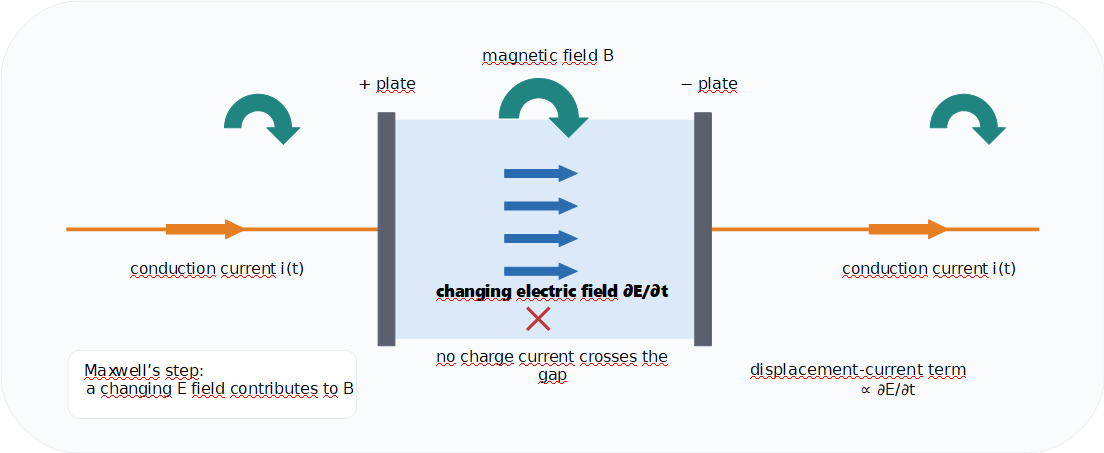
This was not a small correction. It closed the system. Faraday’s law says, in essence, that a changing magnetic field is associated with a circulating electric field. Maxwell’s addition says that a changing electric field is associated with a magnetic field. Together, these ideas allow a self-sustaining electromagnetic disturbance to move through space [5]. The popular explanation says: a changing electric field creates a changing magnetic field, and the changing magnetic field creates a changing electric field, so the wave keeps going. That picture is useful, but it should not be taken too literally as a sequence of little mechanical events, like one gear turning another. Maxwell’s equations describe a coupled field system. The electric and magnetic fields are parts of one electromagnetic structure. In a propagating wave, they are not independent ingredients added together afterward; they are linked aspects of the same physical process [5].
Light becomes electromagnetic
Maxwell’s theory led to one of the most beautiful identifications in physics. When he worked out the consequences of his equations, he found that electromagnetic disturbances should propagate with a definite speed. That speed came out very close to the measured speed of light [7]. This was not a coincidence. Maxwell concluded that light itself is an electromagnetic disturbance [7]. That statement unified two worlds that had previously seemed separate. Electricity, magnetism and optics were not independent branches of nature. Visible light was part of the same phenomenon as electric and magnetic fields. What differed was the frequency and wavelength. This is the moment where radio becomes possible in principle, even before practical radio transmitters exist. If visible light is an electromagnetic wave, then other electromagnetic waves can exist too — waves too long to see, too low in frequency for the eye, but still governed by the same field laws. These would later become radio waves. Maxwell did not build a radio system. He did something more fundamental: he showed that nature allows electromagnetic waves. Historically, this was not a single isolated flash of insight in 1865. Maxwell’s earlier work in the 1850s and early 1860s had already developed Faraday’s field ideas mathematically and introduced the concepts that led to the displacement current. His 1865 paper was the culmination of this development, not a detached miracle in one year [8].
Hertz makes the waves visible
A theory, however elegant, still needs experimental confirmation. That confirmation came from Heinrich Hertz in the late 1880s. Hertz built apparatus that could generate and detect electromagnetic waves in the laboratory. His transmitter used sparks and oscillating currents. His receiver was a small loop or conductor with a tiny gap. When electromagnetic waves from the transmitter reached the receiver, a small spark appeared across the gap [9]. By itself, a spark might not sound like proof of a new kind of wave. Hertz went further. He showed that these disturbances behaved like waves. They could be reflected. They could form interference patterns. They had polarization. They travelled at a speed comparable to the speed of light [9]. That was the decisive bridge from Maxwell’s mathematics to physical reality. The invisible field disturbances predicted by Maxwell were real. They could be generated, radiated, received and studied. Hertz had shown that electromagnetic waves existed outside the visible range.
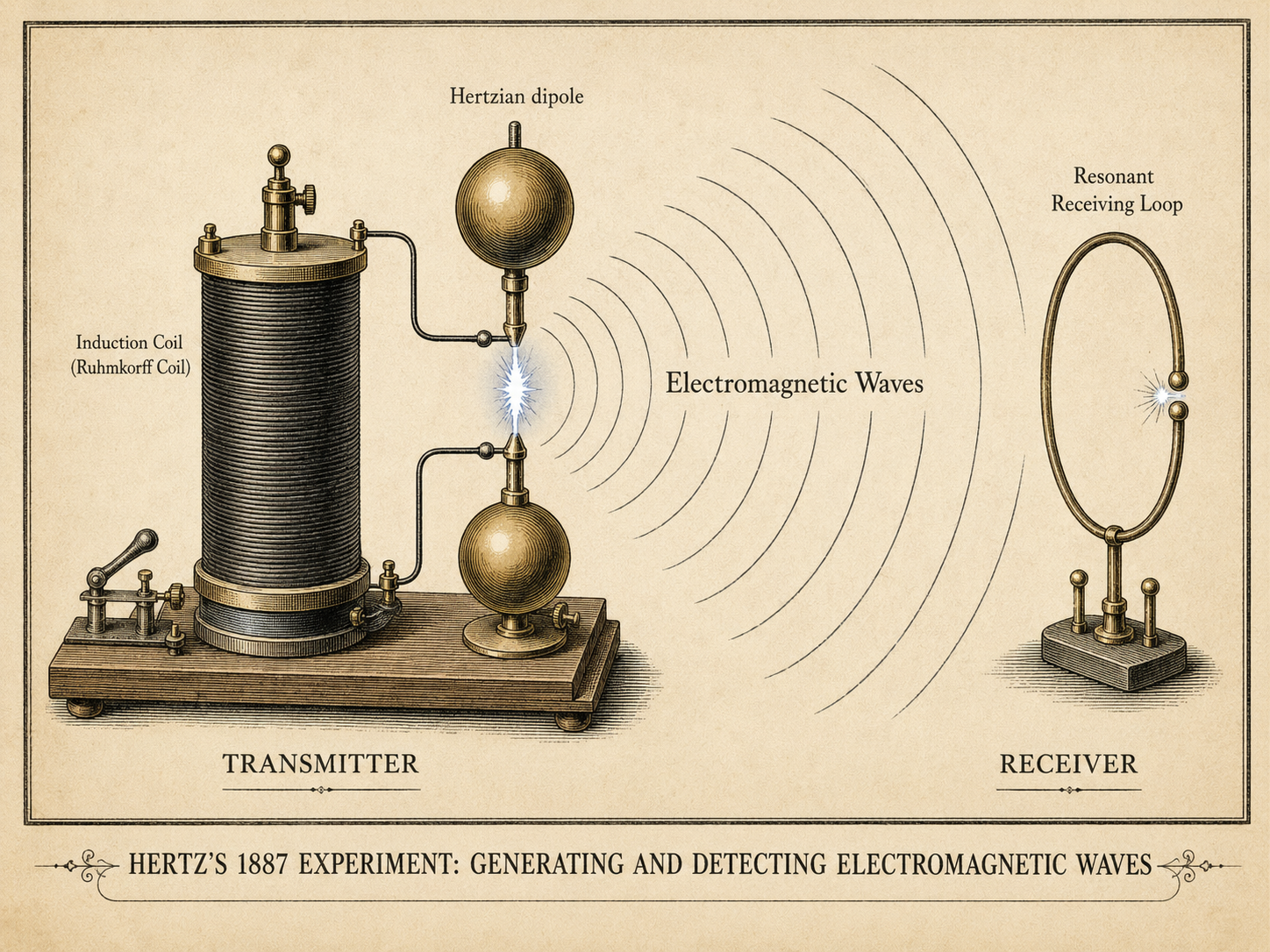
Later engineers would turn this into communication. But Hertz’s experiment was not yet radio in the everyday sense. It was not music, speech or data sent across the world. It was a laboratory demonstration that rapidly changing electric systems can launch electromagnetic waves into space. That demonstration opened the door to everything that followed: wireless telegraphy, broadcasting, radar, satellite communication, Wi-Fi, mobile networks and deep-space communication. A small historical caution is useful here. Tesla, Marconi, Braun, Lodge, Popov and many others belong to the later story of radio engineering and wireless systems. For the physical foundation of electromagnetic waves, however, the central line is Faraday, Maxwell and Hertz. Tesla becomes more relevant when the discussion moves toward high-frequency engineering, resonance and wireless power.
Wavelength, frequency and speed
For electromagnetic waves in vacuum, frequency and wavelength are linked by the speed of light [5], [10]:
c = λ × f
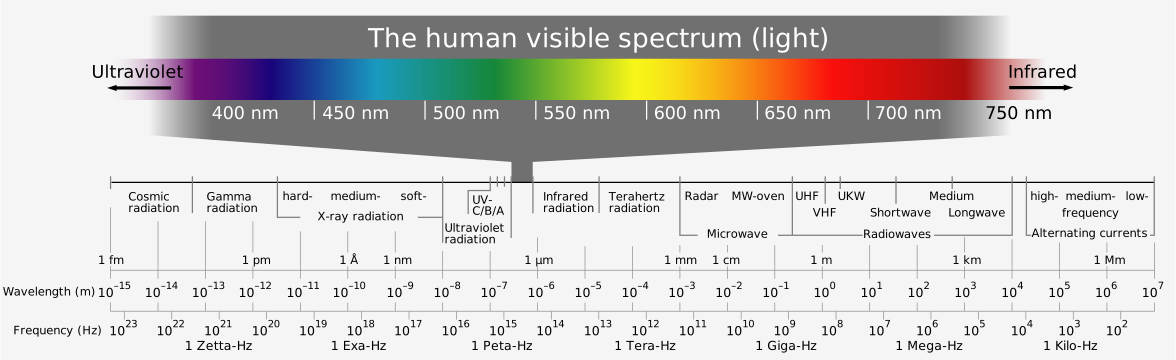
Here, c is the speed of light, λ is the wavelength and f is the frequency. The speed of light in vacuum is exactly 299,792,458 metres per second [10]. This relationship means that high frequency corresponds to short wavelength, and low frequency corresponds to long wavelength. A radio broadcast at around 100 MHz has a wavelength of about 3 metres. A Wi-Fi signal at 2.4 GHz has a wavelength of about 12.5 centimetres. Visible light has wavelengths of only a few hundred nanometres. X-rays are shorter still. This is why antennas, circuits and propagation behaviour change so dramatically with frequency. A component that is electrically small at audio frequencies may be a significant fraction of a wavelength at radio frequencies. A wire that behaves like a simple connection at low frequency can become a transmission line at higher frequency. An opening that is irrelevant at long wavelength can become an effective slot antenna at shorter wavelength. Later chapters will explore these consequences. For now, the basic rule is enough: Frequency, wavelength and propagation speed are inseparable.
Radio, microwaves, light and X-rays
Once Maxwell’s theory is understood, the electromagnetic spectrum becomes conceptually simple. Radio waves, microwaves, infrared radiation, visible light, ultraviolet radiation, X-rays and gamma rays are all electromagnetic radiation. They are not different substances. They are not separate families of waves. They are different regions of the same continuous spectrum [11]. They differ in frequency, wavelength and photon energy. At the low-frequency end, radio waves can have wavelengths from metres to kilometres or more. They are useful for communication, broadcasting, navigation and sensing. Microwaves have shorter wavelengths and are used in radar, satellite links, microwave ovens, Wi-Fi and many other systems. Infrared radiation is associated with heat radiation and optical communication. Visible light is the small part of the spectrum that human eyes can detect. Ultraviolet radiation, X-rays and gamma rays have increasingly high frequencies and increasingly high photon energies [11]. It is therefore both correct and slightly dangerous to say: radio waves and X-rays are the same thing. They are the same kind of physical phenomenon: electromagnetic radiation. But they are not the same in energy, origin or interaction with matter. A medium-wave transmitter, a microwave radar, a laser pointer and an X-ray tube all involve electromagnetic radiation, but they produce it in different ways and interact with matter very differently [11]. The unity is fundamental. The differences are practical and physical. This is one of the reasons radio engineering is so rich. The same Maxwellian physics runs through the entire spectrum, but every frequency range has its own habits.
Wave picture and photon picture
So far, we have described electromagnetic radiation as a wave in electric and magnetic fields. For radio engineering, antennas, transmission lines and propagation, this classical field picture is usually the most useful starting point. Modern physics also describes electromagnetic radiation in terms of photons. A photon is the quantum of the electromagnetic field, and its energy is proportional to frequency [6], [11]. This does not contradict the wave picture. It is a different level of description. For radio waves, the photon energy is usually extremely small compared with thermal energies in ordinary electronics, so classical field theory works remarkably well. For visible light, ultraviolet radiation, X-rays and atomic-scale processes, the photon picture becomes much more important. For the rest of this series we will mostly use the field picture, because it is the natural language for antennas, feed lines, near fields, radiation and energy flow.
Where is the energy?
An electromagnetic wave carries energy. That sentence is familiar, but it hides an important question: where is the energy actually located? It is tempting to imagine energy flowing inside the wire, then jumping into space from the antenna. But field theory gives a more subtle answer. Electromagnetic energy is associated with the electric and magnetic fields themselves. In a propagating wave, energy moves through the field in the direction of propagation [12]. The precise mathematical description uses the Poynting vector, which points in the direction of electromagnetic energy flow. That topic deserves its own chapter and will return later in this series. For this first chapter, the important point is simply this: an electromagnetic wave is not just a pattern with no physical consequence. It can deliver energy to a receiving antenna. It can heat material. It can exert pressure. It can carry information [12]. Radio communication works because controlled changes in the field can be used to transport energy and information from one place to another.
Why antennas matter
If electromagnetic waves are field disturbances, then a radio transmitter needs a way to create such disturbances efficiently. That is the role of an antenna. An antenna is not merely a metal stick from which electrons are thrown into space. The electrons in the antenna do not travel from the transmitter to the receiver. Instead, the transmitter drives charges in the antenna back and forth. These accelerating charges produce changing electric and magnetic fields. Under the right conditions, part of this field structure separates from the immediate vicinity of the antenna and propagates outward as radiation. This is why antenna size is related to wavelength. The geometry of the conductor, the distribution of current and voltage, and the surrounding space all determine how efficiently energy is transferred from the transmitter into the electromagnetic field. A receiving antenna performs the reverse process. The incoming electromagnetic wave exerts forces on charges in the conductor. This creates voltages and currents that the receiver can process. Nothing material has crossed the space between transmitter and receiver. Yet energy and information have. That is the basic miracle of radio.
A short historical timeline
Faraday gave physics a new way of thinking about space. His lines of force suggested that electric and magnetic action should be understood locally, through fields [4]. Maxwell turned this idea into equations. He connected electricity, magnetism and optics into one theory and showed that electromagnetic waves should exist [7], [8]. Hertz generated and detected those waves in the laboratory. He demonstrated that they reflect, interfere, polarize and travel at a speed comparable to light [9]. Later inventors and engineers turned the phenomenon into practical communication. That later engineering story is important, but the physical foundation was already present in the line from Faraday to Maxwell to Hertz. For this reason, the first chapter of a radio physics series should begin not with transmitters, receivers or frequency bands, but with fields. Radio is applied field physics.
The core idea
An electromagnetic wave is a travelling disturbance of electric and magnetic fields. It is produced when charges and currents change in time. In free space, the electric and magnetic components of the wave are coupled and propagate at the speed of light. Radio waves, microwaves, visible light and X-rays are all part of the same electromagnetic spectrum. Their wavelengths, frequencies and photon energies differ enormously, but the underlying field theory is shared. This is the conceptual foundation for everything that follows. When we later ask why antennas radiate, why coaxial cables guide energy, why transformers hardly radiate, why near fields behave differently from far fields, or why different frequencies propagate in different ways, we are still asking questions about the same thing: How electric and magnetic fields exist, change, carry energy and interact with matter. That is the physics behind radio.
Chapter 2: Near Field and Far Field – Why Radio Changes with Distance
Sources and further reading
- OpenStax – College Physics 2e, “Introduction to Electromagnetic Waves.”
https://openstax.org/books/college-physics-2e/pages/24-introduction-to-electromagnetic-waves - OpenStax – Physics, “Electric Field.”
https://openstax.org/books/physics/pages/18-3-electric-field - OpenStax – University Physics Volume 2, “Electric Field Lines.”
https://openstax.org/books/university-physics-volume-2/pages/5-6-electric-field-lines - Assis, André Koch Torres. “The Field Concepts of Faraday and Maxwell.”
https://www.ifi.unicamp.br/~assis/The-field-concepts-of-Faraday-and-Maxwell%282009%29.pdf - OpenStax – University Physics Volume 2, “Maxwell’s Equations and Electromagnetic Waves.”
https://openstax.org/books/university-physics-volume-2/pages/16-1-maxwells-equations-and-electromagnetic-waves - NASA Science – “Anatomy of an Electromagnetic Wave.”
https://science.nasa.gov/ems/02_anatomy/ - Maxwell, James Clerk. “A Dynamical Theory of the Electromagnetic Field.”
https://archive.org/download/dynamicaltheoryo00maxw/dynamicaltheoryo00maxw.pdf - Engineering and Technology History Wiki – “Milestones: Maxwell’s Equations, 1860–1871.”
https://ethw.org/Milestones%3AMaxwell%27s_Equations%2C_1860-1871 - Hertz, Heinrich. “Electric Waves.”
https://commons.princeton.edu/josephhenry/wp-content/uploads/sites/71/2020/02/Electric_Waves.pdf - NIST – CODATA value of the speed of light in vacuum.
https://physics.nist.gov/cuu/Constants/index.html - NASA / GSFC – “Electromagnetic Spectrum: Introduction.”
https://imagine.gsfc.nasa.gov/science/toolbox/emspectrum1.html - OpenStax – University Physics Volume 2, “Energy Carried by Electromagnetic Waves.”
https://openstax.org/books/university-physics-volume-2/pages/16-3-energy-carried-by-electromagnetic-waves